
AI in Financial Planning: Revolutionizing Wealth Management
Why Traditional Financial Planning Is Broken—and How AI Fixes It
AI driven financial planning is not just a futuristic buzzword; it is a powerful and present-day force that is fundamentally revolutionizing wealth management. By harnessing the immense power of machine learning, predictive analytics, and big data, it delivers deeply personalized strategies, automates overwhelmingly complex analysis, and provides actionable, real-time insights that traditional methods simply cannot match. This technology is moving financial advice from a static, rearview-mirror perspective to a dynamic, forward-looking partnership.
Quick Answer: What AI Driven Financial Planning Offers
Personalized strategies: Moves beyond generic templates to create financial roadmaps based on your unique income, goals, and risk tolerance.
Real-time insights: Delivers immediate, actionable intelligence by instantly analyzing thousands of market and personal data points.
Proactive risk management: Continuously monitors your portfolio and financial health, identifying potential risks long before they become problems.
24/7 accessibility: Provides on-demand access to your financial picture and scenario-planning tools via intuitive, AI-powered platforms.
Cost efficiency: Dramatically lowers the cost barrier, democratizing access to the kind of sophisticated advice once reserved for the ultra-wealthy.
Dynamic adaptation: Creates a living financial plan that automatically adjusts and provides recommendations as your life and the markets change.
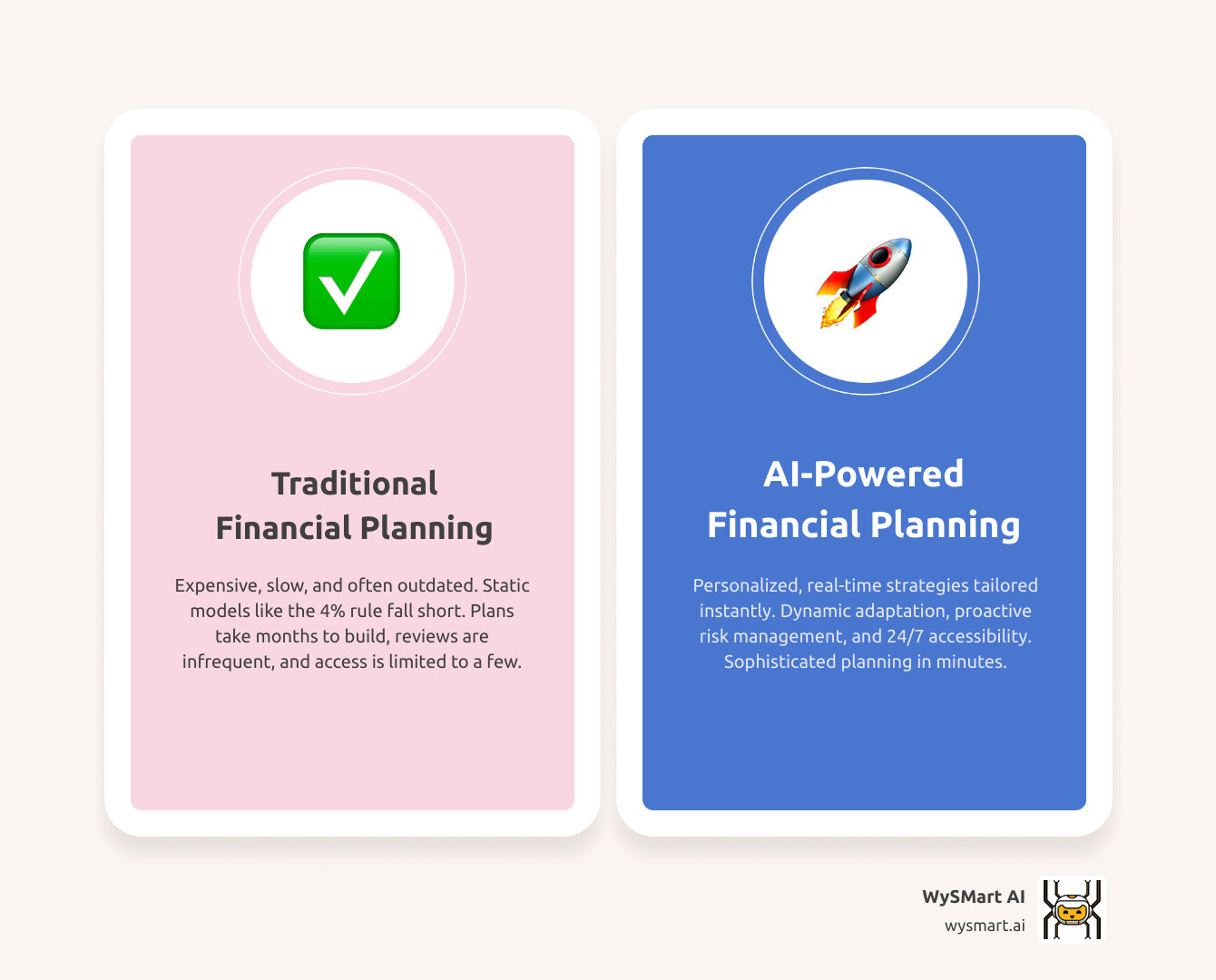
Here's the stark reality: traditional financial planning is failing the majority of people. A staggering only 35% of Americans have a financial plan, leaving most to navigate their financial lives with a mix of guesswork and anxiety. This isn't just a minor oversight; it has profound consequences. With household debt soaring and nearly half of all Americans believing that retiring at 65 is an unrealistic dream, the need for accessible, effective guidance has never been more critical. The traditional model is simply not built for the modern world. It's notoriously expensive, often requiring high minimum asset levels that exclude most households. It's painfully slow, with comprehensive plans taking months to assemble—a timeframe in which your personal circumstances and the global markets can shift dramatically.
Furthermore, the foundational principles of old-school planning are crumbling. Models like the once-sacred 4% retirement rule, which suggested you could safely withdraw 4% of your portfolio annually, were designed for a different economic era of higher bond yields and more predictable market returns. In today's world of increased longevity, persistent inflation, and unprecedented market volatility, such rigid rules can be a recipe for disaster, potentially depleting a nest egg far too early. This creates a massive, dangerous gap between the financial security people desperately need and the outdated, inaccessible advice they are offered. AI is not just bridging that gap; it's building a whole new, modern bridge.
Modern AI platforms can analyze your tax returns, simulate thousands of financial scenarios, and deliver personalized recommendations in minutes, not months. They adapt to market changes and life events in real time, ensuring your strategy remains relevant and effective. It's no surprise that this shift is already well underway; over 90% of asset managers now use AI in their investment processes, with assets under the management of robo-advisors and AI platforms projected to skyrocket to $5.9 trillion by 2027.
Crucially, AI doesn't replace human advisors—it empowers them. It acts as a supercharged analyst, handling the monumental task of data crunching and scenario modeling. This frees up human professionals to focus on the irreplaceable aspects of their job: deep strategic thinking, behavioral coaching, and building trusted relationships. For individuals, AI is a powerful democratizing tool that makes sophisticated, dynamic financial planning accessible and affordable for the first time.
This is about using intelligent tools to make smarter, more confident decisions and stay resiliently on track toward your most important goals. I'm Joey Martin, founder of WySMart AI. We specialize in helping small businesses harness the power of AI for sustainable growth, and I've seen firsthand how AI driven financial planning democratizes sophisticated tools—this is the very same principle that drives our work. Just as AI transforms personal wealth management, it can completely revolutionize how your business attracts customers and thrives in a competitive market.
The AI Advantage: Core Benefits for Modern Wealth Management
The seismic shift to AI driven financial planning is nothing short of revolutionary. It brings a suite of capabilities that were once the stuff of science fiction directly into the hands of everyday investors and their advisors, transforming the landscape of modern wealth management.
This isn't a distant future trend—it's the current reality. According to PwC's 2023 Global Asset & Wealth Management Survey, an overwhelming majority—over 90%—of asset managers are already actively using AI to enhance investment performance and operational efficiency. The industry has recognized that failing to adopt this technology is no longer an option.
AI's formidable power stems from three core advantages that work in concert: hyper-personalization, data-driven accuracy, and unprecedented efficiency. These are the same foundational principles that drive everything we do at WySMart AI—using intelligent, automated technology to deliver tangible results that were once out of reach for small businesses. Learn more about our AI-powered services and how we apply these principles to business growth.
Imagine being able to stress-test your complete financial plan against hundreds of potential economic futures, from market booms to deep recessions, and receiving real-time reports on your progress with clear, actionable insights. This is precisely what AI enables. It leads to faster, smarter, and more confident decisions, with transparent probabilities assigned to different outcomes, removing much of the guesswork that has long plagued personal finance.
Personalized Financial Strategies for Everyone
AI excels at creating financial strategies that fit your unique, complex life, not a generic, off-the-shelf template. For decades, traditional advice has relied on broad categorizations—grouping clients by age or a simple 'conservative' vs. 'aggressive' risk profile. This one-size-fits-all approach ignores the beautiful and messy reality of individual financial lives. AI, by contrast, thrives on complexity. AI driven financial planning platforms can ingest and synthesize your entire financial ecosystem. This includes not just your income and spending, but also your specific goals with their unique timelines and priorities, your true risk tolerance as revealed by your behavior, and significant life events, both past and future.
Consider a modern professional, perhaps a freelance graphic designer. Their income is variable, arriving in unpredictable lumps. They are simultaneously saving for a down payment on a house, paying off student loans, contributing to a SEP-IRA for retirement, and trying to build an emergency fund. A traditional planner might struggle to model this financial juggling act, offering generalized advice that doesn't account for the cash flow volatility. An AI-powered system, however, can analyze years of transaction data to model that irregular income, stress-test the plan against a prolonged 'dry spell' between projects, and create a dynamic hierarchy of savings goals. It can recommend precisely how to allocate a large payment from a client—how much should go to high-interest debt versus long-term investments—to optimize progress on all fronts simultaneously. This level of granular, personalized strategy was once the exclusive domain of ultra-high-net-worth family offices. AI makes it scalable, affordable, and accessible to everyone.
This hyper-personalization is bridging a critical societal gap. Historically, sophisticated, tailored financial advice was a luxury reserved for the wealthy. AI democratizes this expertise, making personalized planning scalable and affordable for a much broader audience. The demand is undeniable: studies show that more women are seeking financial guidance than ever before and younger workers are actively looking for professional help to navigate their financial futures. AI meets this surging demand with advice that adapts to individual goals and circumstances, which in turn improves financial literacy and helps to narrow the persistent wealth gap.
Unprecedented Efficiency and Accuracy

Remember the days when creating a financial plan involved months of tedious paperwork, manual data entry, and culminated in a thick, static binder that was outdated almost as soon as it was printed? AI has completely transformed that archaic experience into a fluid, digital, and instantaneous process.
Modern AI driven financial planning platforms can accomplish in minutes what used to take teams of analysts weeks to complete. They automate the laborious and error-prone tasks of data collection, aggregation, and analysis from disparate sources like bank accounts, investment portfolios, and loan statements. This automation not only saves an immense amount of time but also eliminates the risk of human error—a single misplaced decimal or incorrect entry—that could silently derail an entire financial strategy.
The efficiency gains are truly remarkable. Across the financial services industry, AI applications have already achieved a 45% reduction in case resolution time, a metric that translates directly to vastly improved customer experiences and higher retention rates. When people can get clear, accurate answers to their financial questions quickly, they remain engaged and confident in their plan.
However, speed without accuracy is worthless. AI delivers both in spades. With AI, financial planning cycles are up to 30% quicker, and the resulting forecasts are 20% to 40% more accurate than those produced by traditional, spreadsheet-based methods. This means that instead of waiting for a stressful annual review to discover you've veered off track, AI monitors your progress continuously. It provides proactive alerts and course-correction suggestions the moment a deviation is detected.
It achieves this accuracy by running thousands of Monte Carlo simulations to test your plan's resilience against market crashes, unexpected job changes, sudden illnesses, or other major expenses. This provides a level of predictive forecasting that enables truly proactive decision-making. This isn't about replacing human judgment—it's about supercharging it. AI handles the computational heavy lifting, allowing human advisors to focus their expertise on high-level strategy, client relationships, and behavioral coaching. The bottom line is better decisions, made faster, with a far greater degree of confidence.
How AI Driven Financial Planning Works in Practice
AI driven financial planning is not a theoretical concept; it's a practical tool that is actively changing how both financial advisors and individuals manage wealth today. The key is to understand that AI doesn't just take over. Instead, it becomes your indispensable co-creator and tireless analytical assistant, expertly handling the complex, data-intensive grunt work so that you and your advisor can focus on the strategic big picture.
Modern AI platforms offer a highly interactive and intuitive interface that translates a dizzying amount of complex financial data into clear, visual, and actionable insights. At WySMart AI, we've witnessed this exact transformative shift in the world of digital marketing. When our AI tools handle the relentless data crunching of market trends and customer behavior, our clients are freed up to spend more time on creative strategy and business development. Book a discovery call to see how AI can similarly transform your business.
Generating Baselines and Co-Creating Plans
Every solid financial plan, without exception, starts with a deep and accurate understanding of where you stand today. Traditionally, this has been a tedious, manual process of gathering statements and filling out long questionnaires. AI driven financial planning makes this foundational step remarkably efficient and insightful.
Using advanced technologies like Natural Language Processing (NLP) and Optical Character Recognition (OCR), AI can read and understand your most important financial documents—from tax returns and brokerage statements to complex legal documents like wills, trusts, and insurance policies. It extracts the key details in minutes, not hours. It's not just scanning for keywords; it's comprehending context to build a complete, multi-dimensional picture of your financial life. The AI establishes your comprehensive planning baseline, giving you an immediate, consolidated snapshot of your assets, liabilities, cash flow, and spending patterns.
More importantly, the AI goes beyond simple aggregation. It immediately begins to analyze what's driving your financial outcomes and surfaces powerful, actionable insights. For instance, it might spot potential estate tax reduction strategies based on the structure of your will, quantify the long-term financial value of a Roth conversion, highlight inefficiently structured debt, or identify critical gaps in your insurance coverage. You begin the planning process not with a blank slate, but with an intelligent system that already understands your specific situation and helps you build a robust plan around your unique financial drivers.
Real-Time Simulations and Automated Sense-Checking
Once your comprehensive baseline is established, AI driven financial planning unleashes its most transformative capability: running thousands of sophisticated scenarios to illuminate the potential outcomes of your decisions in real time. This is where financial planning moves from a static report to a dynamic, interactive sandbox for your future. Want to explore the trade-offs between retiring at 60 versus 65? An AI platform can instantly model not just the difference in your final portfolio value, but also the impact on your lifestyle, healthcare costs, and Social Security claiming strategy, presenting the outcomes with clear probability assessments. Wondering how funding a child's Ivy League education will affect your own retirement timeline? The system can show you the precise impact, moment by moment.

These are not the simple, linear projections you'd find in a basic online calculator. They are sophisticated Monte Carlo simulations that model thousands of potential futures, each with different sequences of market returns, inflation rates, and interest rate environments. The AI stress-tests your plan against a vast array of conditions, from 'black swan' market crashes and prolonged recessions to periods of runaway inflation or stagflation. It can even generate detailed SWOT (Strengths, Weaknesses, Opportunities, Threats) analyses for different strategic choices, such as whether to pay down your mortgage early or invest the extra cash. This allows you to visualize the full spectrum of possibilities and their downstream effects, turning abstract financial concepts into tangible, understandable outcomes.
Crucially, the AI acts as a vigilant guardian, automatically sense-checking everything against your stated goals and risk parameters. If a proposed scenario—like taking on a large loan for a vacation home—puts your primary goal of a secure retirement at an unacceptable level of risk or conflicts with your other priorities, the AI flags it immediately with a clear explanation. Your financial plan becomes a living, intelligent strategy, not a static document gathering dust in a drawer.
Monitoring, Adjusting, and Optimizing Your Strategy
The true, long-term value of AI driven financial planning emerges most powerfully in the ongoing monitoring and optimization phase, which is precisely where traditional planning models often fall short. A plan is only useful if it is followed and adjusted, and AI makes this process seamless and proactive.
An AI-powered platform provides continuous, real-time monitoring of your financial performance against the benchmarks set in your plan. This means you get timely, actionable alerts when something requires your attention—long before your next scheduled annual review. Whether it's a significant market shift that has unbalanced your asset allocation, a change in your spending habits that's impacting your savings rate, or a new tax law that creates an optimization opportunity, the AI catches these deviations early and brings them to your attention.
It doesn't just present you with raw data and tell you what's happening; it provides context, telling you why it's happening and suggesting what to do about it. You receive tactical, data-backed recommendations that empower you to make decisions with confidence. This fosters a state of adaptive planning, where your financial strategy constantly evolves in lockstep with your life and the markets. The AI evaluates risks and opportunities in real time, continuously adjusting its recommendations to keep you on the optimal path toward your goals. With this capability, you're no longer just passively tracking progress—you're actively and intelligently steering your financial future with unparalleled precision.
AI vs. Traditional Methods: A New Era for Financial Advice
AI driven financial planning isn't just an incremental improvement or a slightly better version of what came before; it represents a fundamental, paradigm-shifting evolution in how wealth management is delivered and experienced. To fully appreciate the magnitude of this change, it's helpful to compare it directly to the methods that have dominated the world of financial advice for decades.
Traditional human advisors offer invaluable wisdom, emotional intelligence, and judgment, but they are inherently limited by human capacity for data processing and are often associated with high costs and asset minimums, putting sophisticated, personalized planning out of reach for many. At the other end of the spectrum, first-generation robo-advisors successfully automated basic investing and lowered costs, but their capabilities are generally confined to structured portfolio data and rigid, rule-based algorithms. They fall short when it comes to comprehensive, holistic wealth planning that includes taxes, estates, and insurance.
AI driven financial planning masterfully combines the best of both worlds while transcending their respective limitations, creating a new category of financial guidance.
Feature Traditional Human Advisor Robo-Advisor AI-Driven Financial Planning Personalization High, but time-intensive and costly Moderate, based on simple algorithms Hyper-personalized, dynamic, and adaptive Cost High, often a percentage of AUM Low to moderate, flat fee or % AUM Variable, often subscription-based, highly scalable Accessibility Limited, high barrier to entry High, fully online platforms Very high, democratized access to sophisticated tools Data Analysis Manual, limited by human capacity Automated, but for structured data only Automated, for both structured & unstructured data Strategy Complexity High, based on human judgment Moderate, follows rule-based algorithms Very high, predictive, probabilistic, and adaptive Document Analysis Manual, slow, and labor-intensive Minimal or none Automated (NLP/OCR), extracts deep insights Real-time Monitoring Infrequent, typically annual reviews Basic alerts on portfolio drift Continuous, with proactive, actionable insights Behavioral Coaching High, a core strength None, purely algorithmic Limited, but can flag behavioral biases
The Limits of Traditional Models and Robo-Advisors
The old way of doing things is struggling to keep pace with the speed and complexity of modern life. Traditional financial planning is often too slow and static for today's volatile reality. By the time a meticulously crafted annual plan is finalized and delivered, market conditions, interest rates, and personal life events have often rendered parts of it obsolete. Legacy models, such as the 4% retirement rule, were built for a world with different demographics and economic assumptions—a world that, for the most part, no longer exists.
Robo-advisors made a significant contribution by solving the accessibility and cost problem for basic investment management. However, they are fundamentally limited by their rule-based algorithms. They can efficiently rebalance a portfolio of ETFs, but they cannot read and interpret the unstructured data locked within your will, trust documents, or complex executive compensation package. They are a powerful calculator when what you truly need is a strategic partner capable of understanding your entire financial life in context.
The Leap Forward with AI-Driven Financial Planning
This is where AI driven financial planning represents a quantum leap forward. It's not just about doing the old things faster; it's about enabling entirely new capabilities that lead to fundamentally better, more resilient financial plans that adapt to your life in real time.
Dynamic Adaptation and Proactive Management: Your financial strategy transforms from a static, dusty document into a living, breathing entity. AI platforms continuously monitor not only public market data but also your personal financial accounts and life events. When a significant change occurs—a market correction, a salary increase, or even a change in tax law—the system doesn't wait for an annual review. It instantly recalculates thousands of forward-looking scenarios to quantify the impact on your long-term goals. It might alert you that your portfolio is now underweight in a key sector or that a recent bonus provides a perfect opportunity to max out your retirement contributions without impacting your lifestyle, providing a clear, actionable path forward.
Holistic, Cross-Disciplinary Analysis: AI has the unique ability to ingest and interpret vast amounts of both structured (account balances, transaction data) and unstructured (legal documents, insurance policies) data. This allows it to spot complex interdependencies and risks that traditional, siloed planning might miss. For example, an AI could analyze your investment accounts and see a high concentration of your company's stock, cross-reference it with your employment agreement to identify an upcoming vesting schedule for more shares, and then check your stated financial goals to see you plan to retire in five years. It would then flag this as a critical concentration risk and recommend specific, tax-efficient diversification strategies.
Quantifying the Value of Advice: One of the most powerful features of AI is its ability to identify specific planning opportunities—such as an optimal Roth conversion ladder, a tax-loss harvesting strategy, or an estate planning adjustment—and assign a hard dollar amount to the potential savings or value created. This moves financial advice from the realm of the abstract to the concrete, providing clear, actionable insights with a measurable financial impact.
Scaling Specialized Expertise: World-class expertise in complex areas like retirement income planning, tax optimization, and estate law has historically been very expensive and difficult to access. AI helps to codify and scale this expertise, making it available to more people at a fraction of the cost.
Deepening Client-Advisor Relationships: When advisors are empowered by AI to provide more proactive, insightful, and valuable guidance, they build deeper, more resilient bonds of trust with their clients. A recent industry survey revealed that 85% of advisors reported winning new clients specifically because they could offer 'state-of-the-art tech'. For the consumer, this translates into better service, more competitive pricing, and ultimately, better financial outcomes.
At WySMart AI, we are driven by this same principle of technological democratization. Just as AI is leveling the playing field in wealth management, our AI-powered marketing toolbox is making enterprise-level marketing power accessible and affordable for small businesses, enabling them to compete and win.
Navigating the Risks and The Enduring Role of Human Expertise
Like any profoundly powerful technology, the adoption of AI driven financial planning is not without its challenges and considerations. To harness its benefits responsibly, we must proactively address potential risks related to data privacy, cybersecurity, algorithmic bias, and the complex, evolving regulatory landscape. It's much like driving a high-performance car: the speed and power are exhilarating, but you must understand the controls, respect the rules of the road, and remain an alert and engaged driver to arrive at your destination safely.
At WySMart AI, we firmly believe that AI should be a tool for empowerment, not endangerment. We are staunch advocates for a responsible, human-centric approach to AI in finance, just as we prioritize robust security, transparency, and ethical practices for our own clients. If you're curious about how we help businesses protect and manage their digital footprint, you can visit our web help page.
Understanding the Risks of AI in Finance
When dealing with an individual's complete financial history and future aspirations, the stakes could not be higher. Data privacy and cybersecurity are not just features; they are fundamental, non-negotiable requirements.

Data Security Threats: The concentration of sensitive financial data on a single platform makes it an attractive target for malicious actors. The risk of data breaches is real, which means that best-in-class encryption, both in transit and at rest, secure cloud storage architecture, and multi-factor authentication are absolutely essential. You must be able to implicitly trust that your chosen AI platform is guarding your financial data with the utmost intensity.
Algorithmic Bias: AI systems learn from the data they are trained on. If that historical data contains implicit or explicit biases from past human decisions, the AI can inadvertently learn and perpetuate them, potentially leading to unfair or discriminatory outcomes. For example, if historical lending data shows that a certain demographic was approved for loans less frequently, an AI trained on that data might unfairly penalize qualified applicants from that same group. Ensuring algorithmic transparency, fairness audits, and using diverse training data are fundamental to mitigating this risk.
The Evolving Regulatory Landscape: The legal and regulatory framework for AI in finance is still being written. Global regulations like the EU AI Act and principles outlined in the US AI Bill of Rights are setting new standards. Navigating this complex web, which includes existing data privacy laws like GDPR in Europe and CCPA in California, requires constant vigilance and a deep commitment to compliance from any platform provider.
Over-reliance on Technology and the 'Black Box' Problem: AI-generated advice, while powerful, can sometimes be incorrect, lack crucial regional or personal nuance, or be difficult to interpret (the 'black box' problem). As one cybersecurity expert wisely warned, "assume that anything you're putting into these systems is public information," especially when interacting with public, general-purpose chatbots. It is critical to always verify and contextualize AI-generated outputs with trusted human experts before making major decisions.
The Human-AI Synergy: Why Advisors Still Matter
Let's clear up one of the most pervasive misconceptions in the industry: AI is not here to replace your financial advisor. On the contrary, AI driven financial planning is the single greatest force for amplifying the value of human expertise. The most effective way to view this relationship is to think of AI as a brilliant, tireless research assistant and quantitative analyst who never sleeps, makes a calculation error, or forgets a single data point. It can process terabytes of information, run endless simulations, and identify complex patterns that are invisible to the human eye. But for all its analytical power, AI has no empathy. It doesn't understand the fear that grips you during a market crash, the excitement of buying your first home, or the complex family dynamics involved in estate planning. It doesn't know what keeps you up at night. That is the sacred, irreplaceable domain where human advisors shine.
By offloading the laborious, time-consuming tasks of data gathering, analysis, and modeling, AI liberates financial professionals to focus on the high-value, uniquely human aspects of their work. This is the essence of the human-AI synergy. The role of the human advisor is evolving and becoming more valuable, shifting toward:
Complex Problem-Solving and Strategy: Addressing unique, multi-faceted financial situations that require creative, out-of-the-box thinking and strategic judgment that goes beyond the data.
Empathy, Behavioral Coaching, and Trust: Offering crucial emotional support during stressful life events, providing the behavioral coaching needed to stick to a plan during market volatility, and building the deep, long-term trust that is the bedrock of any successful advisory relationship.
Relationship Building and Goal Clarification: Fostering long-term partnerships by truly understanding a client's values, helping them clarify and prioritize conflicting goals, and navigating the delicate financial conversations that arise within families.
Strategic Oversight and Interpretation: Acting as the essential 'human in the loop' to interpret AI outputs, apply critical thinking, question assumptions, and guide clients through the real-world implications of the data-driven recommendations.
The future of financial planning isn't a battle of human versus AI; it's a powerful synergy of human with AI. This combination of machine intelligence and human wisdom creates a service that is far superior to what either could provide alone, making great advisors more valuable and indispensable than ever before.
Frequently Asked Questions about AI in Financial Planning
As with any transformative technology, when people first encounter the concept of AI driven financial planning, they naturally have important questions and concerns. Here are the clear, straight answers to some of the most common inquiries.
Can AI completely replace human financial advisors?
Absolutely not. While this is a common fear, it misunderstands the core value of both AI and human advisors. AI cannot completely replace human financial advisors because it operates in the realm of data and logic, while personal finance is deeply intertwined with human emotion, behavior, and life's unquantifiable complexities. Think of AI as an incredibly powerful co-pilot, not the captain of the ship. It excels at the 'what' and 'how'—what the data says, how different scenarios might play out. It can run millions of calculations, analyze complex tax codes, and spot optimization opportunities with superhuman speed and accuracy.
However, it fundamentally lacks the strategic oversight, emotional intelligence, ethical judgment, and personalized coaching that define a great human advisor. AI can't provide behavioral coaching to talk you out of panic-selling in a downturn. It can't help a couple mediate conflicting financial priorities. It can't understand the nuances of your family's legacy goals or provide the empathetic ear you need after a major life event. The future is a powerful partnership: AI handles the immense computational load, freeing human advisors to focus on you—your goals, your fears, your unique situation, and the strategic decisions that require wisdom, not just data. That human connection is, and will remain, irreplaceable.
Is my financial data safe when using AI planning tools?
This is a critical and perfectly valid question. The security of your sensitive financial data should be your top priority when evaluating any platform. Reputable AI driven financial planning providers understand this and make security their highest priority. They employ a multi-layered security strategy that includes end-to-end encryption for all data in transit and at rest, strict privacy protocols that govern data access, and full compliance with stringent regulations like GDPR and CCPA. Look for platforms that also utilize multi-factor authentication, undergo regular third-party security audits, and use data anonymization techniques wherever possible.
However, it's crucial to recognize that not all AI tools are created equal. You must choose trusted, enterprise-grade providers with transparent and robust data security policies. Be especially cautious with public-facing, general-purpose AI chatbots. As one cybersecurity expert warned, "assume that anything you're putting into these systems is public information." This means being highly selective and informed about the tools you use to handle your financial life. At WySMart AI, we build all of our solutions on a bedrock foundation of enterprise-grade security and client trust.
How can I ensure the AI-generated advice is accurate?
Always verify and contextualize AI-generated advice with a qualified human financial advisor. The most effective way to use these powerful tools is as a 'sparring partner' or an 'idea generator' to explore possibilities, run scenarios, and identify potential opportunities. However, you should always rely on professional human judgment for final, binding decisions.
AI is exceptionally accurate for well-defined, data-driven tasks like tracking a budget, comparing the expense ratios of mutual funds, or calculating the future value of an investment. But comprehensive financial planning involves a tremendous amount of context and nuance that an AI may not grasp, such as industry-specific career risks, unique family health considerations, or hyper-local real estate trends. For any complex strategy involving tax planning, investment selection, or estate law, a human review is not just recommended—it is essential.
The smartest approach is to embrace a 'human-in-the-loop' model. Use the AI for the analytical heavy lifting and to generate a data-driven first draft of your plan. Then, work with a human expert to refine, validate, customize, and implement that plan. This gives you the absolute best of both worlds: the awesome analytical power of AI combined with the irreplaceable wisdom and experience of a trusted human professional.
What is the difference between a robo-advisor and a true AI financial planning platform?
This is an excellent question, as the terms are often used interchangeably but represent different levels of sophistication. A traditional robo-advisor primarily automates investment management. You answer a simple questionnaire, and it uses a rule-based algorithm to place you in a pre-determined portfolio of low-cost funds, which it then rebalances for you. It is a fantastic tool for low-cost, passive investing.
A true AI driven financial planning platform goes much further. It is a holistic wealth management engine. Instead of just managing investments, it analyzes your entire financial life—including taxes, insurance, estate documents, and cash flow—to create a comprehensive and dynamic plan. It uses machine learning and predictive analytics, not just fixed rules, to run simulations, provide proactive advice, and adapt to changes in your life. In short, a robo-advisor automates a single task (investing), while an AI planning platform aims to be a strategic co-pilot for your entire financial journey.
Conclusion: Partnering with AI for a Smarter Financial Future
We have clearly reached a significant turning point in the history of wealth management. The era of static, inaccessible, and often outdated financial advice is drawing to a close. AI driven financial planning is here, and it is a profoundly democratizing force, making personalized, efficient, and deeply insightful financial guidance accessible to everyone, not just a privileged few.
The true beauty of this technological revolution lies not in the replacement of humans, but in the powerful combination of human wisdom and machine intelligence. AI is the ultimate analyst, flawlessly handling the heavy lifting of data aggregation, complex scenario modeling, and vigilant, real-time market monitoring. Human advisors, liberated from these tasks, can then bring their most valuable and irreplaceable skills to the forefront: empathy, behavioral coaching, strategic thinking, and a nuanced, holistic understanding of your life and values. Together, they form a synergistic partnership that is vastly more powerful and effective than either could ever be alone.
For individuals, AI is becoming an always-on, intelligent financial partner that provides clarity and confidence. For advisors, it is a transformative tool that elevates their practice and deepens their client relationships. This collaborative future is the very principle upon which I built WySMart AI. From my experience, I've learned that businesses, just like individuals, thrive when they embrace intelligent technology not as a replacement for human ingenuity, but as a powerful partner that unlocks new potential. The parallels are striking. Just as AI driven financial planning cuts through the complexity and jargon of wealth management to deliver clear, actionable insights for your personal finances, WySMart AI provides an AI-powered digital marketing toolbox that does the same for your business's growth. We are dedicated to democratizing the sophisticated marketing strategies that were once only available to large corporations with massive budgets.
We help small businesses automate time-consuming marketing tasks, attract a steady stream of qualified customers, and build stronger, more resilient brands—all in a stress-free, intuitive platform. Whether you are struggling with SEO Optimization to get found on Google, need to dominate your local market with Local SEO, or want to protect and enhance your online brand with Reputation Management, our done-for-you AI toolbox provides a decisive competitive edge. We eliminate the guesswork and replace it with data-driven precision, allowing you to focus on what you do best: running your business. We are so confident in our ability to deliver results that we offer a risk-free trial and a money-back guarantee.
The future of your financial planning is collaborative, intelligent, and AI-powered. The future of your business growth can be too.
Start your 7-day free trial and see the future of business growth today. Hire your AI employee and transform your online presence with WySMart AI.
