
The Verdict is In: How Content Marketing Can Transform Your Legal Practice
Why Content Marketing for Law Firms Is Your Firm's Most Powerful Growth Engine
Content marketing law firms need to accept isn't just another buzzword—it's the difference between thriving and merely surviving in today's digital-first legal landscape.
Quick Answer: What Content Marketing Law Firms Should Focus On
Blog posts and articles answering common legal questions.
Video content like client testimonials and legal explainers (73% of people prefer learning about services via video).
SEO-optimized website pages targeting keywords potential clients search for.
Social media content that builds trust and showcases your firm's personality.
Email newsletters to nurture leads and keep your firm top-of-mind.
Downloadable guides that capture leads while providing genuine value.
The bottom line: Content marketing generates 3x more leads than traditional marketing while costing 62% less. Leads from organic search also convert at a higher rate (4%) compared to other channels.
Here's the reality: 97% of potential clients start their search for legal services online, yet many firms still rely on referrals and costly traditional advertising. While your competitors appear on Google with helpful articles answering the exact questions your ideal clients are asking, you're invisible—losing cases and revenue to firms that understood content marketing sooner.
When someone faces a legal issue, their first stop isn't the Yellow Pages; it's Google. They're searching for answers, guidance, and a trustworthy expert. Content marketing is how you show up for those searches, demonstrate expertise, and build a consistent pipeline of qualified leads without spending thousands on billboards.
However, real content marketing for law firms requires strategy—understanding your audience, creating valuable content that addresses their needs, and optimizing it for search engines. You need a system that works for you, not another time-consuming task.
I'm Joey Martin, founder of WySMart AI. I've spent years helping law firms leverage content marketing to win in the digital age by changing them from referral-dependent to consistently generating their own qualified leads. In this guide, I'll walk you through how to build a content marketing strategy that drives real results for your firm.
Laying the Foundation: What is Content Marketing and Why Your Firm Needs It
At its core, content marketing is the process of creating and distributing valuable content to attract your target audience and grow your firm. For content marketing law firms, this means offering helpful information that builds an inbound pathway to your services, rather than relying on outdated outbound methods.
Think of it as the difference between shouting from a billboard (outbound) and having clients actively seek you out because you've provided the answers they need (inbound). Inbound is far more effective; leads from organic search convert at a higher rate—around 4%—compared to the 2.4% from other channels. Your expertly crafted articles and videos are powerful lead generators.
Here’s why content marketing is non-negotiable for your law firm:
Building Trust and Credibility: By consistently providing accurate, helpful content, you position your firm as a trusted resource, building confidence before a potential client ever contacts you.
Establishing Your Firm’s Authority: Every blog post or video is an opportunity to showcase your expertise and establish your firm as the go-to expert in your practice area.
Generating Qualified Leads: Content marketing attracts individuals actively searching for legal solutions. These qualified leads can be nurtured with more valuable content, keeping your firm top-of-mind.
Educating Clients: The legal world is confusing. Your content can explain complex topics, answer FAQs, and guide clients through processes, highlighting your firm's commitment to their well-being.
Boosting Online Visibility: With most people using search engines for legal advice, a strong online presence is critical. Our SEO Optimization services ensure your content ranks higher, making your firm visible when potential clients need you.
Industry studies show that small businesses with active blogs get 126% more lead growth than those without. It's a testament to its recognized value in the legal field.
Effective content marketing guides clients through their entire journey: Awareness, Consideration, Conversion, and Retention. Each stage requires a different type of content to meet the potential client where they are.
Awareness Stage: At this initial stage, a person realizes they have a problem or a question, but may not yet know it's a legal issue. They use broad search terms like, "what to do after a car accident" or "my boss fired me unfairly." Your content here should be educational and high-level, such as blog posts, short explainer videos, and infographics that answer these fundamental questions without a hard sales pitch.
Consideration Stage: The individual now understands they have a legal problem and is actively researching potential solutions and law firms. Their searches become more specific: "how to find a good personal injury lawyer" or "Wyoming wrongful termination laws." This is where you provide more in-depth content like detailed guides, case studies, webinars, and comparison articles that showcase your firm's expertise and approach.
Conversion Stage: The potential client is ready to make a decision and hire an attorney. They are looking for signals of trust and reasons to choose your firm over others. Content at this stage includes client testimonials, video interviews with your attorneys, detailed practice area pages that explain your process, and clear calls-to-action for a "free consultation."
Retention Stage: Your relationship doesn't end when a case closes. This stage is about nurturing past clients to encourage repeat business and, more importantly, referrals. Content includes email newsletters with firm updates or relevant legal news, follow-up guides related to their case, and building a community through social media. A happy former client is one of your most powerful marketing assets.
The Difference Between a Content Strategy and a Content Plan
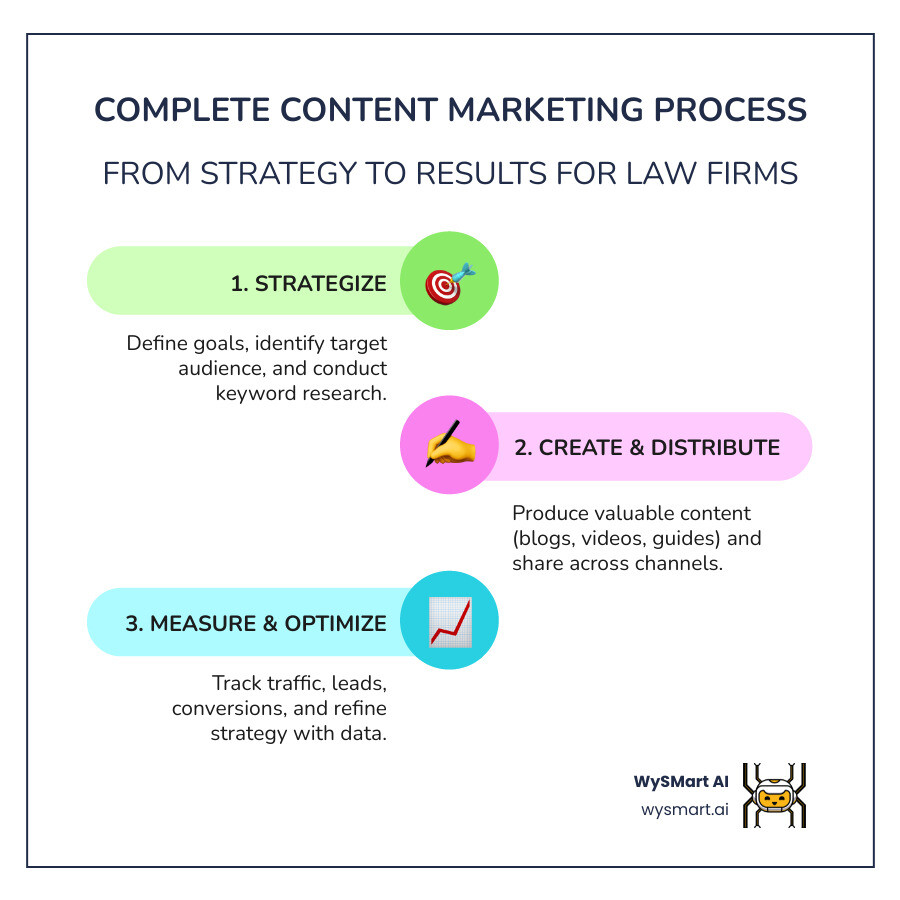
While often used interchangeably, a content strategy is the 'why' behind your content—your goals, audience, and value proposition. A content plan is the 'how'—the actionable steps, topics, formats, and schedules to execute your strategy. Aligning your plan with your strategy ensures every piece of content serves a purpose.
The High Cost of Invisibility

Many law firms still rely on traditional advertising like billboards, which come with a hefty price tag and poor results. The internet is now the primary place people seek legal answers, with over 80% turning to search engines. If your firm isn't visible online, you're invisible to the vast majority of potential clients.
Content marketing, combined with strong SEO Optimization, is the solution. Leads from organic search convert at a high rate (4%), and nearly 80% of law firms list SEO as their most effective marketing channel. Our Local SEO services ensure that when someone in Wyoming searches for legal help, your firm is front and center.
Building Your Case: A Winning Content Marketing Strategy for Law Firms
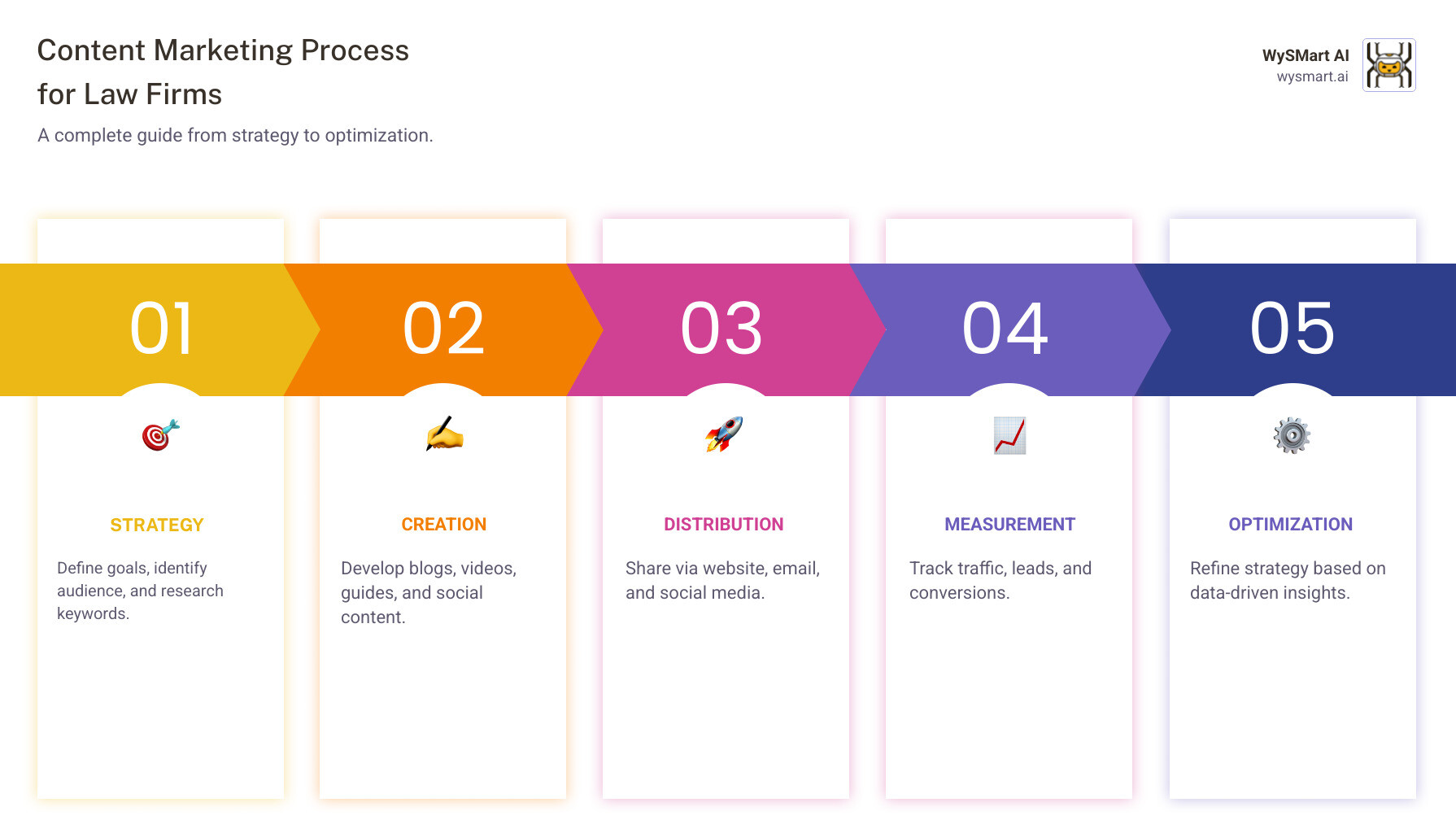
Developing a robust content marketing strategy is like building a strong legal case: it requires meticulous planning and clear objectives. At WySMart AI, we use a structured approach to ensure every piece of content works for your firm.
Step 1: Set SMART Goals and Define Your KPIs
Before creating content, you must know what you want to achieve. We help our law firm clients set SMART goals—Specific, Measurable, Achievable, Relevant, and Time-bound—that align with their objectives.
Common goals for content marketing law firms include:
Brand Awareness: Increasing recognition in your target community.
Lead Generation: Attracting potential clients seeking legal services.
Client Acquisition: Converting leads into signed clients.
Website Traffic: Driving more visitors to your firm's website.
Search Rankings: Improving your Google position for relevant keywords.
Once goals are set, we define Key Performance Indicators (KPIs) to measure progress, such as website visits, conversion rates, or keyword rankings. For example, a lead generation goal might have KPIs like 'number of contact form submissions' or 'phone calls from the website,' while a brand awareness goal might track 'social media shares' and 'branded search volume.'
Step 2: Identify Your Jury: Defining Your Target Audience
To create impactful content, you need to understand your potential clients on a deeper level. Generic content gets ignored; content that speaks directly to a person's specific situation gets results. We work with your firm to:
Understand Client Pain Points: What are their biggest fears or challenges related to your practice area? A person facing foreclosure isn't just worried about the law; they're worried about their family's stability. Addressing these emotional and practical pain points directly shows empathy and provides real value.
Build Audience Personas: We help you develop detailed audience personas—semi-fictional representations of your ideal clients. For instance, a family law firm might target "Divorcing Diane," a 45-year-old mother concerned about child custody and protecting her financial future. She's overwhelmed, searching for compassionate yet firm guidance. Knowing Diane's fears, goals, and the questions she's asking Google allows you to create content that resonates deeply with her and others in her position.
Map the Client Journey: Your content should be custom to each stage of the client journey, from initial awareness of a legal issue to the final conversion when they decide to hire your firm.
Step 3: Conduct Keyword Research to Inform Your Content
In the digital courtroom, keywords are your evidence. Keyword research is pivotal because potential clients need help quickly, and users seldom venture past the first page of search results. If you're not on page one, you're practically invisible.
We use advanced tools to:
Understand Search Intent: We identify not just what people search for, but why. This is critical. For example, someone searching "what is probate" has informational intent and needs an educational article. Someone searching "best probate lawyer in Cheyenne" has transactional intent and is ready to hire. Your content must match this intent. We create top-of-funnel blog posts for informational queries and bottom-of-funnel service pages for transactional ones, ensuring you capture leads at every stage.
Target Long-Tail and Local Keywords: Instead of just "Wyoming lawyer," we target specific, high-intent phrases like "Wyoming family law attorney for child custody modification." These long-tail keywords indicate a user is further along in their journey and more likely to convert. This is where our Local SEO services excel, ensuring you appear for searches happening in your immediate service area.
Analyze Competitors’ Content: We examine what content is performing well for other law firms, identifying gaps and opportunities for your firm to stand out. If competitors have a basic FAQ, we'll help you create a comprehensive video guide that provides far more value.
Step 4: Create and Distribute Your Content
Creating valuable content is only half the battle. Our done-for-you AI toolbox streamlines the entire process.
Build a Content Calendar: Consistency is key. We build an editorial calendar to ensure a steady stream of valuable content, which is crucial as few firms manage to post regularly.
Streamline Your Workflow: We manage the entire workflow, from creation to publication, using project management tools like Trello for efficiency.
Amplify Your Reach: We share your articles and insights on platforms like LinkedIn and Facebook to reach clients who may not find you through search alone. We also leverage our Email Marketing Services to nurture leads.
Repurpose Content for Maximum ROI: We transform your long-form articles into social media snippets, videos, or infographics, ensuring you get the most value from every piece of content. A single, well-researched blog post can be turned into a 10-tweet thread, a 5-slide Instagram carousel, a short explainer video script, and a segment in your monthly email newsletter.
Step 5: Measure the Verdict: KPIs and ROI for Content Marketing
Content marketing is an investment, and you need to track its returns. We use sophisticated analytics to show you the tangible impact of your efforts.
Track Traffic and Conversions: We integrate tools like Google Analytics to monitor website visits, page views, and conversion actions like form submissions or calls.
Monitor Keyword Rankings: We use leading SEO tools to continuously track your rankings for target keywords, allowing us to see what content is driving traffic and leads.
Adjust Strategy Based on Data: We analyze performance data to refine your content strategy, ensuring continuous improvement and optimal results for your firm.
Choosing Your Exhibits: High-Impact Content Formats for Legal Practices
The beauty of content marketing law firms can leverage is its versatility. Different formats serve different purposes and appeal to various audience segments. Our done-for-you AI toolbox helps you create a diverse and effective content portfolio, strategically deploying a mix of formats.
Authoritative Blog Posts and Articles
Blogs and articles are the bread and butter of legal content marketing. They are perfect for:
How-to Guides, Listicles, and Legal Updates: Think "How to file for divorce in Wyoming" or "5 Things to know after a car accident."
Answering FAQs and Explaining Legal Processes: Address common questions to build trust and demonstrate expertise.
Our Content Marketing Strategy Development services ensure your blog posts are not only informative but also optimized for search engines.
Engaging Video Marketing
Video is essential. Research shows that 73% of people prefer to learn about a service through video. We leverage video to:
Client Testimonials and Explainer Videos: Showcase satisfied clients or create short videos that walk someone through a legal process like creating a will.
Showcasing Firm Culture and Expertise: A short video like a TikTok about embracing technology as a lawyer can humanize your firm and attract a wider audience.
Answering Common Legal Questions: We produce short, digestible videos that answer frequently asked questions about your practice areas.
Our Video Marketing services are designed to help your Wyoming law firm harness this powerful medium.
Niche Podcasts and Webinars
Podcasts and webinars allow for deeper dives into legal topics. With over 60 million people listening to podcasts, it's a valuable channel.
Expert Interviews and Deep Dives: Host a podcast, like this example of a Personal Injury Law Podcast, to discuss common scenarios and legal recourse.
Repurposing Webinars: A recorded webinar on estate planning can be transcribed into a blog post, edited into video clips, or used as the basis for an eBook.
Building Trust and Authority: Sharing your knowledge through audio positions your firm as a trusted voice in the Wyoming legal community.
Visual Content: Infographics and Checklists
Visuals can simplify complex legal information. A picture or chart is often worth a thousand words.
Simplifying Complex Data: We create infographics that visually explain topics like common car accident injuries or a divorce process flow chart.
Creating Downloadable Resources: Offer a downloadable checklist for what to do after an accident or a guide to creating a will.
Boosting SEO and Engagement: Visuals make content more engaging and shareable, which can improve your search engine rankings.
Mastering the Courtroom: Best Practices for Engaging & SEO-Friendly Legal Content
The goal of content marketing law firms deploy is to attract, inform, and convert clients. To do this, your content must be engaging for humans and optimized for search engines.
Google's primary objective is to provide a positive user experience. For legal content, which Google classifies as "Your Money or Your Life" (YMYL) content, this means adhering to the strictest standards of quality. The framework for this is known as E-E-A-T: Experience, Expertise, Authoritativeness, and Trustworthiness. As John Mueller of Google says, it's about ensuring your business is legitimate and backed by trustworthy sources. Let's break down what this means for your firm:
Experience: This is the newest addition to the framework. Google wants to see content created by someone with real, first-hand life experience on the topic. For a law firm, this is your superpower. It means going beyond reciting statutes. Share anonymized anecdotes from cases you've handled. Write about the practical, real-world implications of a legal process you've guided dozens of clients through. This demonstrates you've actually been in the trenches.
Expertise: This refers to the creator's formal knowledge and credentials. Your content should be written or reviewed by actual attorneys. Showcase this by including detailed author bios with bar admissions, awards, and links to their professional profiles. This signals to both users and Google that the information comes from a qualified expert.
Authoritativeness: This is about your firm's reputation as a go-to source in your practice area and location. It's built both on and off your website. On-site, it's about having a deep library of comprehensive content. Off-site, it's about earning backlinks from other reputable websites (like legal associations or local news), being cited as an expert, and having a strong profile in legal directories.
Trustworthiness: This is the foundation. Can a user trust you with their sensitive legal problem? Trust is built through accuracy, transparency, and security. Every claim must be fact-checked. You must use clear disclaimers. Your website must be secure (HTTPS), and your contact information, including a physical address, must be easy to find.
Write for Humans, Not Just Search Engines
While SEO is vital, you’re writing for people in distress, not robots.
Keep Language Simple and Direct: Avoid intimidating legal jargon. Your potential client is stressed and confused; your content should provide clarity, not more complexity. Write at an 8th-grade reading level. Instead of "heretofore," say "before." Instead of "interrogatories," explain it as "a set of written questions one party sends to another."
Use Active Voice: "Keep your sentences short, use an active voice, and choose clarity over cleverness." This makes your content more direct, authoritative, and approachable.
Make Content Skimmable: Most visitors skim online content to find the answer they need quickly. Use bolded titles, subheadings, bullet points, and short paragraphs with plenty of white space to make your key information easy to find and digest.
Use Storytelling to Make Legal Content Accessible
Legal topics can be dry, but your content doesn't have to be. Storytelling humanizes your practice and makes complex information relatable and memorable.
Share Case Studies and Success Stories: A compelling, anonymized story about how you helped a family navigate a complex probate process is far more impactful than a generic service description. It shows, rather than tells, your expertise and compassion.
Use Metaphors and Analogies: Amplify your content by including stories, examples, and metaphors to make complex legal terms easy to understand. Explaining the discovery process as "both sides showing their cards before the game begins" makes the concept instantly accessible.
Humanize Your Practice: Share insights into your firm's values, your team's passion for justice, or even a behind-the-scenes look at your community involvement. This builds a connection with potential clients on a human level, fostering trust before they ever pick up the phone.
Adhere to Ethical Guidelines and Build Trust
For law firms, ethical compliance is paramount. Your content must always operate within the strict boundaries set by your state bar association.
Stay Within Legal Advertising Guidelines: Depending on your state, you must adhere to certain limitations on advertising, such as rules against using superlatives or creating unjustified expectations. Our team ensures your content is compliant with these professional conduct rules.
Use Disclaimers and Avoid False Promises: Clearly state that your content is for informational purposes only and does not constitute legal advice or create an attorney-client relationship. Never guarantee outcomes or promise specific results.
Fact-Check All Content: Accuracy is non-negotiable. Research helps you avoid embarrassing mistakes, like what happens when AI “hallucinates” non-existent cases. Meticulously accurate content shows your team is a detail-oriented industry leader.
Finally, don't forget to put an easy-to-follow call to action (CTA) at the end of every piece of content. Tell your reader exactly what to do next, whether it's booking a consultation, downloading a guide, or calling your office. A reader who is informed and engaged needs a clear next step to become a client.
Frequently Asked Questions about Content Marketing for Law Firms
We often hear similar questions from our law firm clients when they're considering content marketing. Let's address the most common ones.
How long does it take for content marketing to show results?
Content marketing is a marathon, not a sprint. It builds momentum over time. While some early wins are possible, significant results in terms of organic traffic, rankings, and consistent leads typically take 3-6 months. Google needs time to recognize a renewed content strategy. Consistency is key; many firms quit just before their efforts start paying off.
What are common mistakes law firms make in content marketing?
Even the smartest legal minds can make marketing blunders. Here are common pitfalls we help firms avoid:
Inconsistent Publishing: Many firms have a blog or social media but fail to post regularly.
Lack of a Clear Strategy: Posting content without a clear "why" or "who" leads to scattershot, ineffective efforts.
Overly Sales-Focused Content: Content should primarily inform and educate, not just sell.
Excessive Legal Jargon: Writing content that only other lawyers can understand alienates potential clients.
Ignoring SEO: Creating great content is useless if no one can find it.
Not Measuring Results: Without tracking KPIs, you're flying blind and can't tell what's working.
Should we handle content marketing in-house or partner with an expert?
This is a classic dilemma. While you have the legal expertise, your time is best spent practicing law. Combining your knowledge with a professional partner is often the ideal solution.
In-House Approach WySMart AI Partnership Deep subject matter expertise (but limited time) AI-powered tools & legal marketing expertise Time-consuming for attorneys (pulls from billable hours) Done-for-you content & automation (frees up your time) May lack digital marketing skills (SEO, analytics) Consistent, data-driven results (we know what works) Limited resources (staff, tools, time) Scalable, cost-effective solutions
We bridge the gap between your legal knowledge and effective digital marketing execution, delivering results while you focus on your clients.
The Final Verdict: Partnering for Sustainable Growth
In today's competitive legal market, the content marketing law firms implement isn't a luxury—it's a necessity. A strategic, consistent approach can transform your practice, moving you from relying on referrals to generating a steady stream of qualified leads.
Content marketing is a long-term asset that builds trust, establishes authority, and ensures your firm is visible to the 97% of clients who start their search online. A data-driven strategy means your content works harder for you, compounding over time to deliver sustainable growth.
At WySMart AI, we offer an unparalleled advantage with our AI-powered toolbox and done-for-you services. We provide comprehensive digital marketing services including SEO Optimization, Local SEO, Website Design Services, Reputation Management, and PPC Management custom for law firms. Our integrated approach means you get the benefits of cutting-edge AI without having to become a marketing expert.
We're confident in our ability to deliver results, which is why we offer a risk-free trial and money-back guarantee. We are here to be your trusted partner, providing the AI Employee Revolution your firm needs to grow smarter and faster.
Ready to transform your legal practice? Book your free findy call with WySMart AI today and start your 7-day free trial!
