
Beyond Spreadsheets: Choosing the Right CRM for Your Law Firm
Why Law Firms Can't Afford to Keep Working Without a CRM
CRM for law firms is no longer optionalit's the difference between growth and getting left behind. If you're searching for the right solution, here's what you need to know. If you're new to the term, here's a quick primer on customer relationship management (CRM).
Quick Answer: Best CRM for Law Firms
Legal-Specific Features: Client intake automation, case management, trust accounting compliance, and conflict checking
Core Capabilities: Automated workflows, centralized document storage, billing integration, and secure client portals
Security Standards: Bank-grade encryption, two-factor authentication, HIPAA/SOC 2 compliance
Key Benefits: Reduce administrative burden by 50+ hours/month, increase client conversion rates, improve team collaboration
Top Considerations: Integration with existing practice management tools, scalability, user-friendly interface, and dedicated legal support
Law firms lose approximately 33 hours each month to nonbillable tasks. That's nearly a full work week spent on administrative busywork instead of winning cases or serving clients. While many firms use some form of CRM, they often rely on scattered spreadsheets and manual processes that lead to costly mistakes. Missing a single follow-up could mean losing a $50,000 case.
The administrative burden is real. Research shows 74% of small businesses feel overwhelmed by these tasks, and for law firms, the stakes are even higher. Every missed deadline or lost document puts your reputation and revenue at risk. The good news? 84% of law firms report increased efficiency after implementing legal technology. The right CRM transforms chaos into clarity and manual processes into automated workflows.
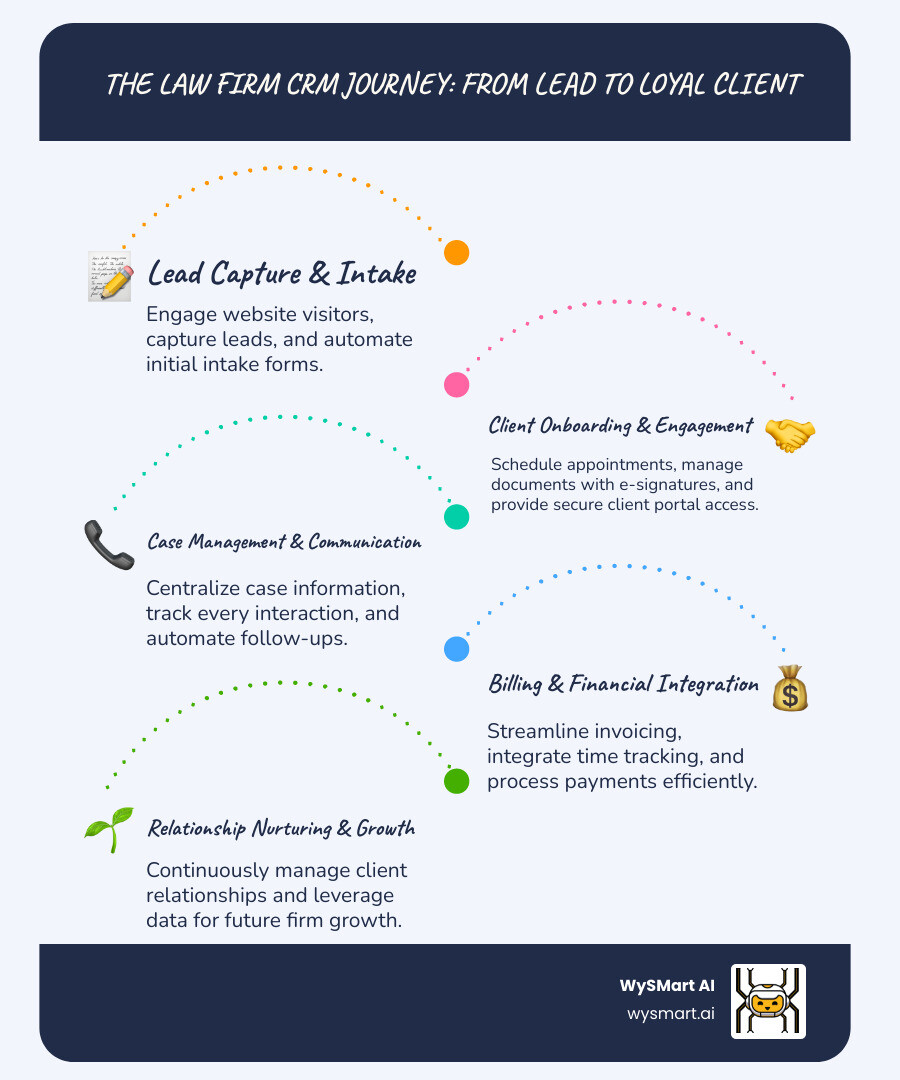
A modern CRM for law firms acts as your firm's central nervous systemmanaging intake, tracking interactions, automating follow-ups, securing documents, and streamlining billing. The ability to manage relationships and operations efficiently at scale is what separates firms that thrive from those that merely survive.
I'm Joey Martin, founder of WySMart AI. We specialize in AI-powered solutions that give law firms a done-for-you digital toolbox, acting like a full marketing and operations team without the overhead. In this guide, I'll walk you through choosing the right CRM for your practice, from must-have features to the real-world results you can expect.
Why Your Firm Needs a Strategic CRM (and Not Just a Better Spreadsheet)
Spreadsheets were never designed to run a law firm. They can't manage complex client relationships, track dozens of cases, or keep your team in sync. A strategic CRM for law firms isn't just a fancy contact list; it's the difference between spending your days buried in administrative chaos and actually having time to practice law.
When you move from spreadsheets to a real CRM, operational efficiency skyrockets. Repetitive tasks like sending follow-up emails, tracking deadlines, and updating client records get automated. Your team stops wasting time on busywork and starts focusing on billable hours. The numbers back this up: 84% of law firms report increased efficiency after implementing legal technology.
Beyond efficiency, the real magic happens in client engagement. Today's clients expect a professional, personalized experience. A CRM makes this possible by centralizing every detail about every client interaction, creating one source of truth for all client and case information. No more hunting through emails or wondering if a follow-up was handled. This level of professionalism is what sets successful firms apart.
Learn more about WySMart AI's AI-powered legal solutions
Better Client Relationships and Engagement
In legal practice, trust is everything. A CRM for law firms helps build that trust by enabling personalized communication at scale. The system remembers client preferences, so every interaction feels custom and attentive. This single source of truth eliminates the embarrassing and unprofessional scenario where a client has to repeat their story to multiple people at your firm. Instead, any team member can access the complete history of communications, documents, and notes, allowing them to engage with the client intelligently and empathetically. Proactive communication becomes simple. The system can automatically send reminders for upcoming appointments or court dates, and even personalized messages for milestones like birthdays or the anniversary of a case closing, fostering long-term loyalty and generating referrals.
Client portals further build confidence by giving clients secure, 24/7 access to case updates and documents, reducing their anxiety and your team's workload. By providing a secure, self-service hub for clients to view documents, check case status, and communicate with your team, you drastically reduce the volume of "just checking in" phone calls and emails. This not only frees up your staff but also empowers clients, giving them the confidence and peace of mind that their case is being actively managed. According to Salesforce research, 76% of clients prefer different communication channels depending on the context; a CRM helps you meet clients where they are, turning good service into exceptional experiences.
Boosted Operational Efficiency
The mountain of administrative work in a law office—intake forms, scheduling, filing, time tracking—is relentless. A CRM for law firms attacks this problem by automating nonbillable tasks. Imagine a new lead's information automatically populating your system, triggering welcome emails and scheduling follow-up tasks without anyone touching a keyboard. Consider the entire client lifecycle. Workflow automation can create a standardized checklist for every new personal injury case, automatically assigning tasks to paralegals for medical record requests and setting deadlines for filing motions. Document generation tools can pull client data directly from the CRM to populate engagement letters, discovery requests, and other standard forms, eliminating hours of tedious copy-and-pasting and reducing the risk of clerical errors.
Time tracking, when integrated, becomes a seamless part of the workflow rather than a dreaded end-of-day task. Every call, email, and document prepared can be logged against the correct matter with a single click, ensuring that billable work is never forgotten. This systematic reduction of manual data entry is not just about saving time; it's about creating a more accurate, reliable, and auditable operational foundation for your firm, minimizing human error and giving your team back hours they can spend on substantive legal work.

Data-Driven Growth and Decision Making
Running a law firm on guesswork is a risk you don't need to take. A robust CRM for law firms transforms your data into clear reporting and analytics. A CRM with strong analytics capabilities allows you to move beyond intuition. You can generate reports that show lead conversion rates by practice area, helping you understand which services are in highest demand. You can analyze the average case value and profitability per referral source, finally answering the question of whether that expensive legal directory subscription is paying for itself. Tracking marketing ROI becomes crystal clear, showing you exactly which campaigns generate leads and what those clients are worth.
Attorney performance metrics, such as billable hours logged versus targets, or client satisfaction scores, can be tracked to identify coaching opportunities and reward top performers. This data also empowers strategic financial forecasting. By understanding your client acquisition pipeline and historical revenue trends, you can project future income with greater accuracy, making informed decisions about hiring, expansion, and technology investments. At WySMart AI, our solutions are designed to surface these critical insights, transforming raw data into a clear roadmap for sustainable growth and helping you build what comes next.
10 Must-Have Features in a Modern CRM for Law Firms
Choosing the right CRM for law firms means focusing on features that solve the unique demands of legal practice. A generic system built for selling widgets won't handle trust accounting or flag conflicts of interest. We've identified ten essential features that separate transformative legal CRMs from the rest. These are the critical components that will change how your firm operates, serves clients, and grows.

1. Automated Client Intake and Lead Management
Your first interaction with a potential client is critical, and this initial experience sets the tone for the entire relationship. A sophisticated CRM transforms this touchpoint with dynamic intake forms that use conditional logic to adapt to client responses, gathering more qualified information upfront. It visualizes your conversion process with lead tracking pipelines and eliminates email back-and-forth with automated appointment scheduling. By integrating e-signatures for fee agreements, you remove friction and shorten the time from initial contact to retained client, dramatically reducing client drop-off and preventing them from shopping for other attorneys.
Get help with your website's lead capture
2. Centralized Case and Document Management
Siloed information is a major risk. A unified client profile should provide a complete history of every conversation, document, and case note in one place. This ensures that anyone authorized on the team can get a complete, up-to-the-minute understanding of a case, which is crucial for covering for a sick colleague or bringing a new attorney up to speed. Document storage and version control ensure you're always working on the latest draft, with a clear audit trail. Mandatory conflict of interest checking is a critical safeguard, automatically scanning for potential issues against all past and present clients and related parties before you accept a new client, protecting your firm from costly ethical violations.
3. Integrated Billing and Financial Tracking
The right CRM makes billing less painful and directly impacts your firm's cash flow. Automated invoicing generates bills from tracked time and expenses, speeding up your billing cycle so you can get paid sooner. Timekeeping integration captures every billable minute accurately. A legal-specific CRM understands various fee structures—hourly, flat-fee, contingency, and hybrid models—and can manage them without complex workarounds. For legal practices, trust accounting compliance is non-negotiable. A specialized legal CRM manages client funds according to strict regulatory standards, keeping them separate from firm operating funds and generating the reports needed for IOLTA compliance and audits.
4. Robust Security and Compliance Safeguards
For a law firm, a data breach isn't just an IT problem; it's a potential malpractice claim and a catastrophic blow to your reputation. A CRM for law firms must feature bank-grade data encryption, both in transit and at rest, as a bare minimum. It needs two-factor authentication and granular access controls to ensure a junior associate can't view sensitive partner-level financial data. Reputable cloud security offers physical security, disaster recovery, and 24/7 monitoring that most firms can't replicate in-house, protecting your data from fire, flood, or theft. The system must also help you adhere to legal ethics and privacy regulations like HIPAA and GDPR.

5. AI-Powered Automation and Insights
Artificial intelligence is the force multiplier for a modern law firm. A CRM for law firms with AI can handle repetitive administrative duties like categorizing documents and scheduling follow-ups. Beyond simple automation, it can provide intelligent insights. For example, AI can scan incoming client emails and suggest a priority level based on sentiment analysis, flagging urgent issues. At WySMart AI, we leverage AI to automate the mundane, like automated data entry and document tagging, freeing up your legal professionals to focus on strategic thinking, client advocacy, and other high-value tasks. Relationship intelligence can even identify cross-sell opportunities within your existing client base.
6. Seamless Team Collaboration Tools
Legal work is a team sport, and effective collaboration is the bedrock of consistent client service, especially with the rise of remote and hybrid work models. A CRM should act as a collaboration hub with shared calendars to prevent double-booking client meetings or court appearances. Task assignment features allow partners to delegate duties with clear deadlines and automated reminders. Internal messaging provides a secure alternative to scattered emails or texts. A centralized communication log ensures any team member can pick up a case file and have the full context, which is essential for maintaining service quality and efficiency.
7. Legal-Specific CRM Functionality
This is the most important differentiator. Generic business CRMs fail law firms because they lack essential legal features. A generic CRM might track 'customers' and 'deals,' but a law firm needs to track 'clients,' 'matters,' and 'conflicts.' A true CRM for law firms includes built-in conflict checking to prevent ethical violations, understands complex court calendaring rules to automatically calculate deadlines, and provides compliant trust accounting features. Generic systems don't offer IOLTA compliance, a non-negotiable requirement for any firm handling client funds. Using a system with legal-specific terminology and workflows means you're not fighting your technology with clunky, risky workarounds.
8. Marketing Automation and Pipeline Management
A great CRM helps you grow your practice proactively. Email marketing campaigns and lead nurturing sequences keep you top-of-mind with prospects and past clients, guiding them through the decision-making process automatically. You can create automated drip campaigns to nurture new leads who aren't ready to hire immediately. Segmentation is key, allowing you to send highly relevant messages, like an estate planning update to former estate clients. Performance tracking closes the loop, showing you the ROI of your Google Ads, social media efforts, or referral program, helping you optimize your strategy and budget.
Discover WySMart AI’s marketing automation tools
9. User Adoption and Training Support
The best CRM is worthless if your team won't use it. Success starts with an intuitive interface that feels logical and mirrors a legal workflow. But successful implementation goes beyond the software. A comprehensive onboarding process and ongoing support are crucial. Look for a provider that acts as a partner, offering training customized to your firm's specific workflows. At WySMart AI, we understand that change management is key, so we provide dedicated support to ensure your team feels confident and empowered. Customization options and scalability ensure the system adapts to your practice as it grows, improving adoption and long-term value.
10. ROI and Cost Considerations
Investing in a CRM makes clear financial sense and should be viewed through the lens of return. While most have a per-user, per-month cost, the ROI comes from time savings (reclaiming nonbillable hours), increased client retention, and higher conversion rates for new leads. Calculate the value of just a few billable hours recovered each month per attorney. Add the value of one or two new clients captured per month who might have otherwise fallen through the cracks. When streamlined intake and automated follow-ups ensure no prospect is lost, your marketing investment turns into more revenue, making a CRM a revenue-generating engine, not a cost center.
Frequently Asked Questions about CRM for Law Firms
How do I choose the right CRM for my small law firm?
Choosing the right CRM is a critical decision. Start by assembling a small team that includes not just attorneys, but also the paralegals and administrative staff who will use the system daily. Their input is invaluable. Map out your current processes, especially for client intake and case management, and identify the biggest bottlenecks and points of failure. Use this map to create a checklist of 'must-have' versus 'nice-to-have' features. Prioritize legal-specific functions like conflict checking, trust accounting, and matter-centric organization. Ensure it integrates smoothly with your essential tools like email (Outlook/Gmail), document storage (Dropbox/Google Drive), and accounting software (QuickBooks). Finally, choose a system that can scale. Your firm of three people today might be ten in a few years; the CRM should support that growth without requiring a painful migration. Always insist on a live demo and a free trial. WySMart AI offers a risk-free trial, allowing you to experience firsthand how our AI-powered solutions can be tailored to your practice before you make any commitment.
How can a CRM help my firm get more clients?
A CRM for law firms is a powerful tool for client acquisition and your firm's growth engine. It starts by professionalizing your intake. When a potential client fills out your website form, the CRM can instantly send a personalized email confirming receipt and providing a link to schedule a consultation, making a powerful first impression and putting you ahead of competitors. But its real power lies in automated follow-ups and reminders to nurture that lead over time. For a lead who isn't ready to commit, the CRM can automatically send a series of helpful, non-salesy emails over several weeks—perhaps an article about their legal issue, a client testimonial, or an FAQ. This keeps your firm top-of-mind, building trust and authority so that when they are ready, you are their first call. Most importantly, a CRM provides campaign effectiveness tracking, showing you exactly which marketing channels and referral sources bring in your best clients. This allows you to stop guessing and invest your marketing budget where it will generate the highest return.
Discover WySMart AI's marketing automation tools to see how we help law firms turn more leads into retained clients.
Is it difficult to switch to a new CRM system?
The thought of migrating data and learning a new system can feel daunting, but the long-term benefits far outweigh the short-term adjustment. A good partner makes all the difference. WySMart AI offers comprehensive data migration support to take the heavy lifting off your plate, ensuring your client contacts, case files, and notes are transferred securely and accurately. We use a phased rollout approach to minimize disruption. For example, we might start by implementing the CRM for just the client intake team or for a single practice area. This allows a small group to become experts and champions for the new system before it's rolled out firm-wide. We also provide custom staff training that is tailored to your firm's real-world processes. When your team sees how the CRM makes their daily work easier—less data entry, fewer missed follow-ups, and quicker access to information—adoption happens naturally. With our risk-free trial and money-back guarantee, you can experience the benefits without the risk.
Book your WySMart AI discovery call today and let us show you how smooth this transition can be.
Conclusion: Your Firm's New Engine for Growth
As we've seen, a modern CRM for law firms is not just another piece of software—it's the strategic asset that separates thriving practices from those struggling to keep up. It's your firm's central nervous system, automating repetitive tasks, centralizing data, and changing client interactions into seamless, professional experiences. When you're not buried in busywork, you can focus on what you do best: delivering exceptional legal services.
At WySMart AI, our mission is to empower law firms with technology that actually works. Our done-for-you AI toolbox gives you the power of a full marketing and operations team without the overhead. We combine cutting-edge AI automation with legal marketing expertise in a system that is intuitive, secure, and designed for the real world.
The future of law firm management is here. By combining a powerful CRM with a strategic digital marketing approach, you create an unstoppable growth engine. We're so confident in our solution that we back it with a risk-free trial and money-back guarantee. You'll see real results, or you don't pay.
Ready to transform your practice from administrative chaos to an engine for growth?
Book your WySMart AI discovery call today and see the future of law firm management—risk-free!
