
Marketing Magic: Strategies to Make Your Law Firm Shine
Why Your Law Firm Can't Afford to Be Invisible
Legal marketing strategy is the comprehensive, long-term plan that defines precisely how your law firm will attract, engage, and retain the clients you want to serve. In a marketplace that has become more saturated and competitive than ever before, a solid, well-researched strategy is not merely an option—it's the essential foundation for survival, growth, and long-term profitability.
A well-crafted legal marketing strategy is the definitive solution to the dreaded "feast or famine" cycle that plagues so many law firms. This cycle, characterized by periods of being overwhelmed with casework followed by stressful lulls with no new clients, is a direct result of reactive, inconsistent marketing. A proactive strategy replaces this uncertainty with a predictable, steady flow of qualified clients. It achieves this by systematically aligning your firm's core strengths and expertise with the specific needs and pain points of your ideal clients, all while meticulously complying with the strict ethical standards that govern legal advertising.
Core Components of an Effective Legal Marketing Strategy:
Brand Identity & Unique Selling Proposition (USP) - This goes beyond a logo. It's about defining your firm's core values, mission, and what makes you uniquely valuable in a sea of competitors.
Target Audience Analysis - You cannot be all things to all people. This involves creating detailed profiles of your ideal clients, understanding their demographics, challenges, and where they look for legal help.
Market & Competitive Research - A deep dive into the competitive landscape. This means knowing who your competitors are, what they do well, what they do poorly, and where the opportunities lie for your firm to stand out.
Digital Presence Optimization - Your online footprint is your modern-day storefront. This includes a professional, high-performing website, robust Search Engine Optimization (SEO), and a strategic social media presence.
Content Marketing - The practice of creating and distributing valuable, relevant content (blogs, articles, videos) to demonstrate your expertise, build authority, and earn client trust before they ever contact you.
Client Acquisition Tactics - The specific methods you will use to generate leads, including organic search (SEO), paid advertising (PPC), referral programs, and professional networking.
Measurement & Analytics - The commitment to tracking key performance indicators (KPIs) and Return on Investment (ROI) to understand what's working, what isn't, and how to continuously improve your efforts.
According to the American Bar Association, there are over 1.3 million lawyers in the U.S. alone. When a person or business needs legal assistance, they no longer reach for the Yellow Pages; their journey begins on Google, continues on social media, and is heavily influenced by online reviews. If your firm isn't prominently visible in these digital spaces, you are effectively invisible to the vast majority of potential clients.
You don't need a massive budget to compete and win. With the right strategy, consistent execution, and modern tools, even solo practitioners and small firms can build a thriving, profitable practice.
I'm Joey Martin, founder of WySMart AI. I've dedicated my career to helping legal professionals demystify digital marketing, implementing data-driven legal marketing strategies that drive real, measurable results through AI-powered automation. In this comprehensive guide, I'll walk you through every step of building a powerful strategy that works for your specific firm, from defining your unique brand to measuring your return on investment.
The Blueprint for Growth: Legal Marketing Strategy vs. Marketing Plan
Many lawyers and law firm administrators use the terms legal marketing strategy and marketing plan interchangeably, but this common confusion can lead to wasted resources and stalled growth. Understanding the fundamental difference between the two is the first critical step toward achieving sustainable, predictable success.
Think of the relationship like building a house. Your strategy is the architectural blueprint. It's the high-level vision that defines the purpose and style of the house, who it's for (the family's needs), and its position on the property to maximize views and sunlight. It answers the big-picture "why" and "what" questions that guide the entire project. Your marketing plan, on the other hand, is the construction schedule and list of materials. It's the detailed, tactical roadmap that outlines the specific steps, timelines, budgets, and subcontractors needed to bring the blueprint to life. It answers the practical "how," "who," and "when" questions.
A strategy without a plan is just a dream—a beautiful blueprint with no one to build it. A plan without a strategy is just busy work—a construction crew laying bricks randomly with no blueprint to follow, resulting in chaos and wasted effort.
Your strategy is the foundational thinking that answers the most important questions: Who are our ideal clients and what are their deepest pain points? What makes our firm the uniquely best choice to solve their problems? How do we want to be perceived in the market? It defines your target audience, clarifies your brand positioning, and articulates your compelling Unique Selling Proposition (USP).
Your marketing plan is the operational document that gets specific and actionable. It lays out the precise tactics (e.g., a monthly content calendar, a Google Ads campaign targeting specific keywords), timelines for execution, a detailed budget allocation, and the Key Performance Indicators (KPIs) you'll use to measure success and justify the investment.
The ultimate purpose of integrating both is to build enduring profitability and finally escape the stressful, unpredictable feast-or-famine cycle by attracting a consistent stream of the right clients.
Feature Marketing Strategy (The 'Why') Marketing Plan (The 'How') Purpose Defines long-term vision, goals, and overall approach to the market. Outlines specific actions, tactics, and campaigns to achieve strategic goals. Focus High-level, conceptual, directional, and foundational. Detailed, operational, actionable, and executional. Components Target audience personas, brand positioning, unique selling proposition, market analysis. Budget, timelines, specific channels (SEO, social media, email), content calendar, KPIs. Timeframe Long-term (e.g., 3-5 years), reviewed annually. Short-to-medium term (e.g., quarterly, annually), reviewed monthly or quarterly. Question Answered Why are we marketing? What do we want to achieve in the long run? How will we execute our strategy this quarter? Who will do what, and when?
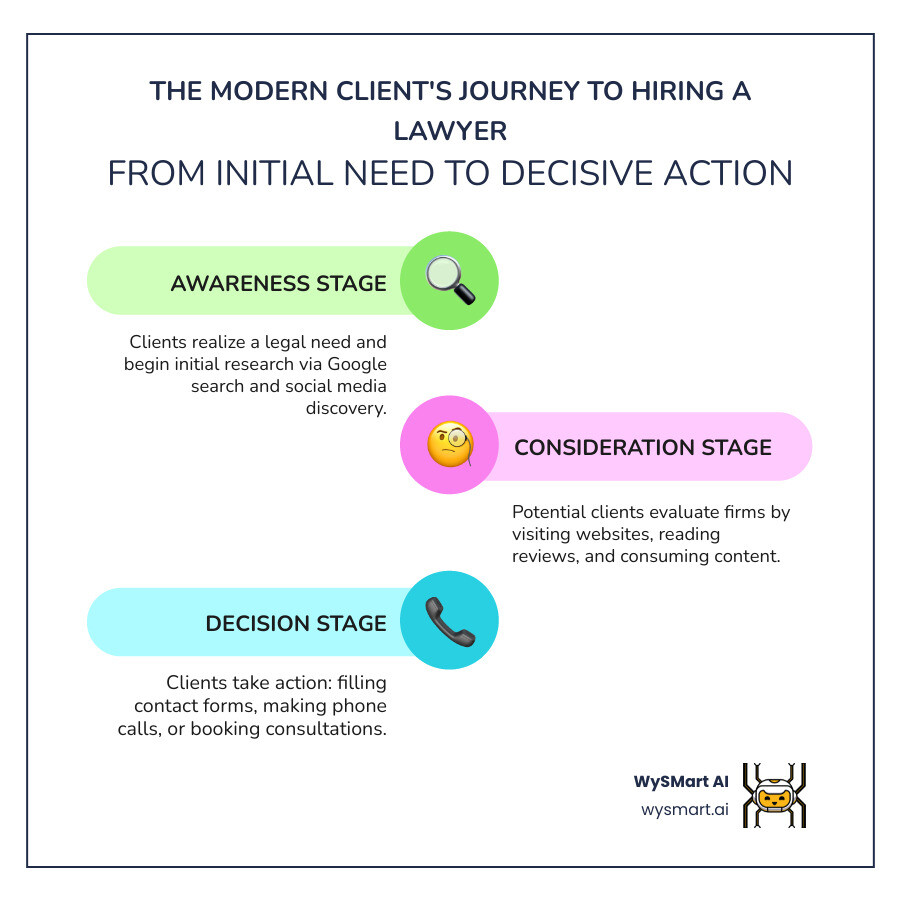
Understanding the marketing funnel is crucial for developing both your strategy and your plan. Your marketing must be designed to meet potential clients with the right message at each stage of their journey:
Awareness (Top of Funnel): A person realizes they have a legal problem (e.g., "my business partner is stealing," "I was hurt in a car accident") and starts searching for information, not necessarily a lawyer yet. Your goal is to be visible and helpful through search engine results for informational queries, social media content, and local listings. You are the helpful expert, not the aggressive salesperson.
Consideration (Middle of Funnel): They are now aware they need a lawyer and are actively evaluating their options. They're visiting firm websites, comparing services, reading online reviews, and consuming your content (blogs, videos) to gauge your expertise and credibility. Your website, testimonials, and case studies are critical here.
Decision (Bottom of Funnel): They have narrowed their choices and are ready to hire. Your marketing at this stage should make it incredibly easy and compelling for them to contact you. This includes clear calls-to-action, easy-to-use contact forms, click-to-call phone numbers, and a seamless consultation booking process.
What is a Legal Marketing Strategy?
Your legal marketing strategy is the foundational compass for your firm's growth. It is not about chasing individual tactics like posting on social media or running an ad. It's about establishing direction and purpose. It defines your high-level, ambitious goals (e.g., becoming the most recognized firm for tech startups in Austin), identifies your target audience in granular detail (not just "businesses," but "SaaS founders with 5-20 employees seeking Series A funding"), and crystallizes your Unique Selling Proposition (USP)—the one compelling reason that makes you the best and only choice for your ideal clients. Without a clear strategy, your marketing efforts are just shots in the dark, destined to be inefficient and ineffective.
How is a Marketing Plan Different?
If the strategy is the destination on a map, the marketing plan is the turn-by-turn GPS navigation. It is the execution roadmap that translates your high-level strategy into concrete, daily, weekly, and monthly actions. A solid plan includes specific tactics (e.g., "publish two blog posts per month targeting long-tail keywords," "run a Google Ads campaign for 'DUI lawyer Chicago' with a budget of $2,000/month"), timelines with clear deadlines, a detailed budget, and the KPIs (e.g., 'cost per lead,' 'website conversion rate') you will use to track progress. This structured, data-driven approach ensures your marketing efforts are not just random activities but measurable actions moving you deliberately toward your strategic goals, allowing for continuous improvement and optimization over time.
Building Your Winning Legal Marketing Strategy: The 4 Core Pillars

Think of your legal marketing strategy as the foundational structure of a skyscraper. Without these four core pillars, deeply embedded and interconnected, your marketing efforts will lack direction, stability, and the strength to deliver consistent, long-term results. These pillars work in concert to attract the right clients, powerfully communicate your value, and position your firm for sustainable, profitable growth in a competitive legal landscape.
Pillar 1: Define Your Firm's Brand and Unique Selling Proposition (USP)
Your brand is far more than a logo or a color scheme; it's your firm's reputation, its personality, and the promise you make to every client. In a crowded market where every competitor claims to be "experienced" and "aggressive," simply being a "good" lawyer is not a differentiator. You must clearly and compellingly articulate what makes you different and better for a specific type of client. This is your Unique Selling Proposition (USP). It must be the sharp, memorable answer to the question: "Why should a potential client hire you over any other lawyer?"
Examples of strong USPs:
For a family law firm: "We guide professionals through complex, high-asset divorces with discretion and financial savvy."
For a personal injury firm: "We only handle catastrophic injury cases, dedicating our full resources to securing maximum compensation for life-altering events."
For a business lawyer: "The flat-fee, on-demand general counsel for tech startups, from formation to funding."
Your core messages must consistently reflect your firm's values, strengths, and USP across all platforms. Your visual identity—including your logo, website design, business cards, and even office décor—must look professional and align with your brand positioning, as it creates a powerful and often instant first impression. WySMart AI's logo design and branding services can help you forge a polished, cohesive image that builds immediate credibility and trust. Finally, you must set SMART goals (Specific, Measurable, Achievable, Relevant, Time-bound) for your branding efforts (e.g., "Increase branded search queries by 20% in the next 12 months") to keep your strategy focused and accountable.
Pillar 2: Identify and Understand Your Ideal Client
You cannot effectively market to everyone. The most successful and profitable firms know exactly who they serve and tailor their entire marketing approach to that specific audience. The process begins with creating ideal client personas—semi-fictional representations of your perfect client. These personas go far beyond basic demographics (age, location, income). More importantly, they delve into their psychographics, including their deepest pain points, fears, motivations, and goals. A personal injury client isn't just thinking about a lawsuit; they are scared, in pain, and worried about paying their mortgage. A business owner facing litigation isn't just dealing with a legal issue; they are stressed about protecting their life's work and their employees' livelihoods. When you understand these powerful emotional drivers, your marketing stops being an advertisement and starts being a conversation that offers a solution.
Understanding the client journey is equally critical. How do they research their problem? What questions do they type into Google? Do they ask for recommendations on Facebook or LinkedIn? Knowing this allows you to meet them with the right information, on the right platform, at the right time. WySMart AI's customer engagement and persona-building tools leverage AI-driven insights to help you understand your audience at a granular level, transforming marketing guesswork into a precise, targeted, and empathetic conversation.
Pillar 3: Conduct In-Depth Market and Competitive Analysis
Just as you would never enter a courtroom without researching the opposing counsel and the judge, you must not enter the marketing arena without a thorough analysis of your market and competitors. First, identify your direct and indirect competitors—who else is vying for the attention of your ideal client? Once identified, perform a SWOT analysis (Strengths, Weaknesses, Opportunities, Threats) on your own firm and on your top 3-5 competitors.
Strengths: What are you better at than anyone else? (e.g., deep niche expertise, a track record of specific case wins, exceptional client service).
Weaknesses: Where do you fall short? (e.g., a dated website, no online reviews, limited budget).
Opportunities: What external factors can you leverage? (e.g., a new local regulation creating legal needs, a competitor with a bad reputation, an underserved niche).
Threats: What external factors could harm you? (e.g., a new, well-funded competitor, negative economic trends, changes in advertising rules).
Scrutinize their digital presence: Use tools to see what keywords they rank for in Google. Analyze their social media activity—are they getting engagement? Read their online reviews to see what clients love and hate about them. This deep analysis reveals gaps in the market and invaluable opportunities for you to differentiate your firm. Your goal is not to copy your competitors but to find your unique angle and exploit their weaknesses. If every other firm's website is cold and corporate, you can win by being more personable and approachable. If no one is using video to explain complex legal topics in your practice area, that's your opportunity to dominate. A thorough market analysis allows you to strategically position your firm as the clear and obvious choice for your ideal clients.
Pillar 4: Determine Pricing and Promotional Tactics
Your pricing strategy is a powerful marketing tool that directly impacts your profitability, your brand perception, and the type of clients you attract. Whether you use hourly rates, flat fees, contingency models, or even subscription services, your pricing must be a reflection of the value you deliver, not just the time you spend. Pricing sends a strong brand message. Premium pricing aligns with a high-stakes, top-tier litigation brand, while transparent flat fees can attract startups and individuals who value budget predictability.
Consider the pros and cons of different models:
Hourly: Traditional and easy to track, but can create client anxiety about costs.
Flat Fee: Excellent for predictable work (e.g., estate plans, uncontested divorces). Clients love the certainty.
Contingency: Aligns your interests with the client's, making legal services accessible for PI and other plaintiffs' cases.
Subscription: A growing model for business clients, providing ongoing access for a predictable monthly fee.
Promotional tactics are designed to lower the barrier to entry and encourage potential clients to take the first step. Free consultations or case assessments are classic examples, but you can also offer free downloadable guides (e.g., "The 10-Step Guide to Starting a Business in Texas"), host informational webinars, or provide a free contract review. Ensure these offers are valuable and align with your overall brand positioning. WySMart AI provides pricing strategy support to help you align your pricing and promotions with your brand, target audience, and growth goals, ensuring every marketing dollar is strategically invested to deliver maximum return.
Executing the Plan: Modern Tactics to Attract, Engage, and Retain Clients

A brilliant legal marketing strategy is purely theoretical without disciplined, effective execution. In the modern legal marketplace, execution means deploying a sophisticated mix of digital tactics designed to build a powerful online presence that consistently attracts, engages, and retains high-value clients. Today's clients are empowered researchers; they expect to find, evaluate, and form an opinion about you online, often making their hiring decision before ever picking up the phone.
Dominating Digital Search with SEO and a High-Performance Website
Your website is your firm's digital hub—your 24/7 salesperson, primary information source, and first impression. To be effective, it must be more than just an online brochure. It needs to be professional, fast-loading, user-friendly, and, most importantly, mobile-friendly. The majority of initial searches for legal services now happen on smartphones. If your site is slow, difficult to navigate, or broken on a mobile device, you've lost a potential client in seconds.
Search Engine Optimization (SEO) is the science and art of making your firm visible to people actively searching for your services on Google. It's the single most important long-term marketing investment a law firm can make. SEO can be broken down into three key areas:
On-Page SEO: Optimizing the content and structure of your website pages. This includes strategic keyword research and placement, writing compelling title tags and meta descriptions, using header tags (H1, H2, H3) to structure content, and creating a logical internal linking structure.
Local SEO: This is absolutely critical for firms that serve a specific geographic area. The cornerstone of Local SEO is optimizing your Google Business Profile (GBP). A complete and active GBP is often the first thing a local searcher sees, appearing in the valuable "map pack" results. WySMart AI specializes in Google My Business management to ensure you appear prominently for valuable local searches. Maintaining NAP consistency (Name, Address, Phone number) across all online directories is another crucial ranking factor.
Off-Page SEO: This involves building your firm's authority and trust in the eyes of Google. The primary method is building high-quality backlinks—links from other reputable websites to yours. These are like votes of confidence. You can earn them through guest posting on relevant blogs, getting listed in reputable legal directories, sponsoring local events, and creating content so valuable that others naturally want to link to it.
AI is rapidly changing how people search for legal help. Find How AI Is Changing Legal Search in 2025 ›. At WySMart AI, we offer AI-powered website design and SEO services that are built to keep your firm visible and competitive in this evolving landscape.
Building Authority with Content Marketing and Social Proof
Any lawyer can claim to be an expert; content marketing and social proof are how you prove it. Content marketing involves creating and distributing valuable, relevant, and consistent content to attract and retain a clearly defined audience. Instead of pitching your services, you are providing genuinely helpful information that solves problems. This could be blog posts answering common legal questions ("What are the first steps after a car accident?"), videos explaining complex legal processes, or downloadable checklists. This approach demonstrates your expertise, builds trust, and positions you as the go-to authority in your field, attracting clients who are already convinced of your value.
What truly seals the deal for most potential clients is social proof. In the digital age, client testimonials and online reviews are the most powerful form of word-of-mouth marketing. Potential clients trust the unfiltered opinions of other clients far more than they trust your own marketing copy. A steady stream of recent, positive reviews on Google, Avvo, and other platforms dramatically impacts your search visibility, credibility, and conversion rates. WySMart AI offers comprehensive reputation management and content creation services to help you systematically generate positive reviews and build and maintain that crucial 5-star reputation.
Engaging Your Audience Through Social Media and Email
Your potential and past clients are on social media every single day. A strategic presence on the right platforms is a massive opportunity to build your brand and stay top-of-mind. The key is to choose your platforms wisely and provide value, not just self-promotion.
LinkedIn is excellent for B2B services, corporate law, and establishing yourself as a thought leader among peers and potential business clients.
Facebook and Instagram are powerful for B2C practice areas like family law, personal injury, and estate planning, allowing you to connect with your local community through targeted ads and helpful content.
Email marketing remains one of the highest ROI marketing channels available. It is a powerful tool for lead nurturing and client retention. Use an email newsletter to stay connected with prospects who visited your website but weren't ready to hire, sending them valuable content that guides them through the consideration stage. For past clients, email is the perfect way to maintain the relationship, share firm news, and gently encourage referrals. WySMart AI offers email marketing services with powerful automation that makes staying in touch with hundreds or thousands of contacts effortless.
Leveraging Your Network and Referral Systems
While digital marketing is essential, don't abandon the time-tested power of traditional relationship-building. Referrals and networking continue to be a significant source of high-quality business for the most successful firms. The key is to be systematic. Building referral pipelines means actively identifying and cultivating relationships with other attorneys in different practice areas and with professionals in related fields (e.g., accountants, financial advisors, real estate agents, therapists).
Peer networking through local and national bar associations and community involvement (e.g., joining a local chamber of commerce or a non-profit board) also raises your profile and builds genuine, trust-based connections. WySMart AI can help you integrate and track these offline efforts as part of your comprehensive legal marketing strategy, creating a complete, holistic growth system for your firm.
Measuring Success, Staying Compliant, and Scaling Up

A legal marketing strategy is a living document, not a one-time project. It requires constant monitoring, data-driven adjustment, and a vigilant eye on ethical compliance. The law firms that achieve sustainable growth are those that obsessively track their results, adhere strictly to professional guidelines, and have the wisdom to know when to scale their efforts by bringing in expert help.
Measuring Your Legal Marketing Strategy's ROI
If you're not measuring your marketing, you're not marketing—you're guessing. Tracking your Return on Investment (ROI) is the only way to know which of your efforts are generating profitable clients and which are wasting precious time and money. To do this effectively, you must focus on a handful of Key Performance Indicators (KPIs):
Website Traffic & User Behavior: How many people are visiting your site? Where are they coming from (organic search, social media, paid ads)? How long do they stay?
Conversion Rate: This is one of the most important metrics. What percentage of your website visitors take a desired action (e.g., call your office, fill out a contact form, book a consultation)? A high traffic number with a low conversion rate indicates a problem with your website or messaging.
Lead Sources: Where are your best, most profitable clients coming from? Is it your Google Ads campaign, your SEO efforts, or referrals from a specific accountant? Knowing this tells you where to double down on your investment.
Client Acquisition Cost (CAC): How much does it cost, on average, to acquire a new client from each marketing channel? To calculate this, divide the total channel spend over a period (e.g., monthly Google Ads cost) by the number of new clients acquired from that channel in the same period.
Client Lifetime Value (LTV): What is the total average revenue a new client will generate for your firm over the entire course of their relationship with you? A high LTV justifies a higher CAC.
Bounce Rate: What percentage of visitors leave your site after viewing only one page? A high bounce rate can signal a mismatch between your ad/search result and your landing page content, or a poor user experience.
Google Analytics is the standard tool for gathering this data, but the raw data can be overwhelming and difficult to interpret. WySMart AI's analytics and reporting tools are designed to translate this complex data into clear, actionable insights, showing you exactly what's working so you're never guessing about your marketing ROI.
Playing by the Rules: Ethical Considerations in Legal Advertising
Legal marketing operates under a strict set of ethical guidelines enforced by state bar associations. A violation, even an unintentional one, can lead to serious professional consequences, from public reprimands and fines to suspension or even disbarment. While rules vary by state, they are generally based on the ABA Model Rules of Professional Conduct. Key principles include:
Truthful Advertising (ABA Model Rule 7.1): All communications about a lawyer's services must be truthful and not misleading. You cannot make claims that are not factually verifiable, create unjustified expectations, or promise specific outcomes.
Professionalism and Dignity: Your marketing reflects not just on your firm, but on the entire legal profession. Avoid sensational, dramatized, or undignified content that could bring the profession into disrepute.
Labeling Advertisements (ABA Model Rule 7.2): Most jurisdictions require that marketing materials be clearly labeled as "Advertising Material."
Client Confidentiality and Testimonials: You must always get explicit, informed client consent before using their name, story, or case results in a testimonial or case study. Even with consent, you must be careful not to reveal any confidential information.
Navigating the complexities of digital promotion—from website disclaimers to social media posts—requires a partner who understands these rules. WySMart AI helps you design and execute your marketing strategy in a way that is both effective and fully compliant with your firm's ethical obligations.
When to Outsource Your Marketing Efforts
You became a lawyer to practice law, not to become an expert in keyword research, conversion rate optimization, and social media algorithms. If you find yourself spending hours on marketing tasks that you could be billing to clients, you are losing money. Outsourcing your marketing to a specialized agency or consultancy makes strategic sense when you lack the time, expertise, or internal resources to execute a comprehensive marketing strategy effectively.
Hiring a single full-time in-house marketer is not only expensive (salary, benefits, overhead), but it's also nearly impossible to find one person who is a true expert in all facets of modern marketing—SEO, content writing, paid ads, social media, analytics, and web design. A specialized agency brings a team of experts and access to expensive, cutting-edge tools at a fraction of the cost of a full-time hire.
The key is to choose a partner that deeply understands the legal industry's unique challenges, opportunities, and ethical constraints. WySMart AI offers done-for-you, AI-powered digital marketing services specifically designed for law firms like yours. We handle the complex, time-consuming work—from SEO strategy and content creation to reputation management and ad campaigns—while you focus on serving your clients. We are so confident in our ability to deliver measurable results that we offer a risk-free trial and money-back guarantee.
Frequently Asked Questions about Legal Marketing
How much should a law firm spend on marketing?
There is no single magic number, but a common guideline used by many professional service firms is to allocate 2% to 5% of your gross annual revenue to your marketing budget. However, this is just a starting point and should be adjusted based on your firm's specific situation and goals. A brand-new practice or a firm entering a highly competitive market (like personal injury in a major city) may need to invest more heavily—perhaps 7% to 10% or more—in the initial years to gain traction and build brand awareness. An established firm with a strong referral base might spend less.
The most important factor is not the percentage, but achieving a positive return on investment (ROI). Instead of thinking of marketing as an expense, view it as an investment. If you can prove that for every $1 you spend on a specific channel (like Google Ads), you generate $5 in revenue, that channel is profitable and worth scaling. The goal is to build a marketing machine where your investment consistently produces a greater return. WySMart AI offers flexible packages designed for solo practitioners and small firms, allowing you to start with a manageable investment and scale up as your firm grows and your ROI is proven.
How long does it take to see results from legal marketing?
Patience and consistency are essential virtues in legal marketing. The timeline for seeing tangible results depends heavily on the tactics you employ:
SEO (Search Engine Optimization) is a long-term strategy. Think of it like planting a tree, not flipping a switch. It typically takes three to six months to see initial positive movement in organic search rankings for less competitive keywords. For more competitive terms, it can take six to twelve months or more to achieve first-page visibility. However, the results from SEO are sustainable and compound over time, delivering the highest quality leads at the lowest long-term cost.
Pay-per-click (PPC) advertising (like Google Ads) can deliver immediate visibility and leads. Your ads can appear at the top of search results within hours of launching a campaign. This is ideal for generating quick wins and gathering data while your long-term SEO strategy matures.
Content Marketing builds authority and organic traffic over time. As your library of helpful blog posts, articles, and videos grows, so does your website's authority in the eyes of Google and potential clients. You might see traffic from a single blog post months or even years after it was published.
Remember the marketing 'Rule of 7': a prospect often needs to see or interact with your firm's message at least seven times before they are ready to take action. This is why a consistent, multi-channel approach is so critical. WySMart AI's transparent, real-time reporting ensures you always know how your campaigns are progressing and what milestones are being hit along the way.
What is the single most effective marketing tactic for a new law firm?
For a new law firm that serves a local or regional client base, the single most effective approach is not one tactic, but a powerful trifecta: 1) Hyper-local SEO, 2) Aggressive Google Business Profile optimization, and 3) Proactive online review generation.
This combination is so effective because it makes your new firm both findable and credible at the exact moment a potential client needs you.
Local SEO ensures you appear in searches like "family lawyer near me" or "criminal defense attorney in [Your City]." This targets people with immediate, high-intent legal needs.
Your Google Business Profile (GBP) is your most valuable piece of digital real estate. It's the box that appears in Google Maps and at the top of local search results, featuring your firm's name, address, phone number, hours, and—most importantly—your reviews.
Online reviews are the modern word-of-mouth and the ultimate form of social proof. A strong collection of positive, recent reviews builds immense trust with prospects and is one of the most significant ranking factors for your GBP.
This trifecta creates a powerful flywheel effect: generating good reviews boosts your GBP ranking, which drives more visibility and leads, which results in more clients who can then leave you more positive reviews. WySMart AI specializes in Local SEO and reputation management services, providing the tools and expert support to help you dominate your local market right from day one.
The Verdict: A Growth-Focused Future for Your Firm
Throughout my years helping law firms grow, I've learned one undeniable truth: the firms that thrive are not necessarily the ones with the biggest names or the largest marketing budgets. They are the ones with a clear, focused, and data-driven legal marketing strategy that they execute with relentless consistency. Without this strategic foundation, your website, social media posts, and advertisements are just scattered, disconnected efforts that cannot support sustainable, profitable growth. They are expenses, not investments.
Your potential clients are online right now. They are searching for answers to their urgent legal questions, comparing law firms, and reading reviews to decide who they can trust with their most sensitive problems. If your firm is not visible, credible, and compelling in those crucial digital moments, a competitor will be. They will get the call, they will get the consultation, and they will get the client that should have been yours.
The good news is that you do not have to navigate this complex digital world alone. You don't have to become a marketing expert on top of being a legal expert. At WySMart AI, we founded our company on the belief that solo practitioners and small law firms deserve the same powerful marketing tools and expertise as large, Am Law 100 firms, but without the prohibitive complexity or high cost. Our AI-powered toolbox and expert done-for-you services are specifically designed to solve the biggest challenges law firms face: achieving high-ranking SEO that gets you found, building a 5-star reputation that builds trust, and implementing a complete digital marketing system that brings in a predictable flow of qualified leads.
We handle the technical, time-consuming details of marketing so you can dedicate your valuable time to what you do best: practicing law and serving your clients. We know that in the legal profession, trust is everything. It must be earned. That's why we back our services with a risk-free trial and a money-back guarantee.
Your firm's expertise deserves to be seen by the clients who need it most. It's time to move beyond reactive, hope-based marketing and adopt a proactive, data-driven approach that delivers real, measurable results.
Book your WySMart AI Findy Call, Start your 7-day free trial, or Hire your AI employee today.
