
From Clicks to Conversions: A Guide to Paid Search Management
Why Paid Search Management is Critical for Small Business Success
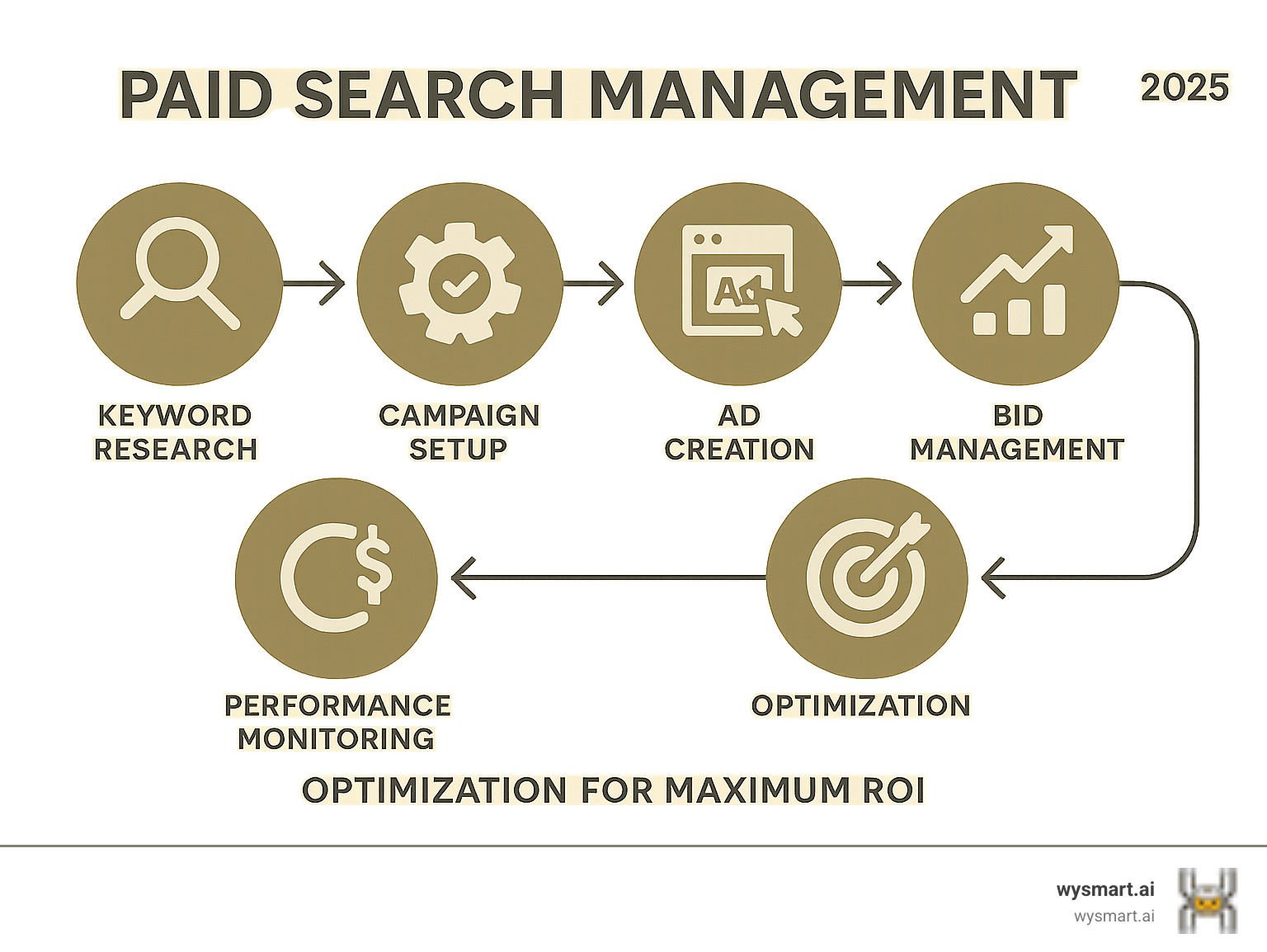
Paid search management is the strategic oversight of pay-per-click (PPC) campaigns on search engines like Google and Bing. It involves:
Campaign Strategy: Aligning ad plans with business goals.
Keyword Research: Finding the terms your customers use.
Ad Creation: Writing ads that drive clicks and conversions.
Bid Management: Setting and adjusting your cost per click.
Performance Tracking: Monitoring results to optimize ROI.
Budget Control: Managing your ad spend effectively.
Simply put, when someone searches for what you sell, paid search puts your business at the top of the results, delivering immediate visibility. While SEO is a long-term game, paid search offers instant traffic.
The numbers are compelling: Businesses average $2 in revenue for every $1 spent on Google Ads, and search ads often convert at more than twice the rate of organic results. With billions of daily Google searches, it's a huge opportunity.
But effective paid search management isn't just about spending money. It requires strategy and constant monitoring to avoid costly mistakes.
I'm Joey Martin, founder of WySMart.ai. I've spent years helping small businesses master digital marketing. As an agency partner, we pair PPC with our AI-driven e-commerce SEO, Local Maps and Google listings, email, SMS, PR, backlinks, and end-to-end customer communications—so every click turns into a conversation and, ideally, a customer. We'll be publishing more data and case studies on our site soon; for now, here's the distilled playbook we use to help clients turn paid search into a growth engine.
Paid Search 101: Understanding the Battlefield
Let's break down paid search management. At its core is Pay-Per-Click (PPC) advertising, the backbone of Search Engine Marketing (SEM). Instead of waiting for customers to find you organically, you pay for a front-row seat in the search results. You pay a small fee each time someone clicks your ad—like a digital salesperson who only gets paid for bringing someone to your door.
The benefits are clear: increased visibility at the top of search results, targeted advertising aimed at active searchers, and measurable results tracking every click and conversion.
How does this compare to SEO? Think of SEO as planting an oak tree—it takes time but yields lasting results. Paid search is like renting a billboard on the busiest street—instant visibility for a recurring cost.
Feature Paid Search (PPC) Organic SEO Speed of Results Immediate visibility and traffic Takes weeks, months, or even years Cost Model Pay-per-click (CPC); direct ad spend Investment in content, technical optimization Control Full control over ad copy, targeting, budget Less direct control; relies on algorithms Longevity Stops when you stop paying Results can be long-lasting Visibility Top of SERP, marked as "Ad" Below paid ads, in organic listings Flexibility Highly adaptable to promotions, A/B tests Slower to adapt to rapid changes
The smartest strategy combines both, dominating paid and organic search results.
Why Paid Search is a Game-Changer for Small Businesses
For small businesses, paid search is a superpower. It levels the playing field, allowing you to compete with larger companies by being smarter, not just by spending more.
Precise Targeting: This goes far beyond just keywords. You can reach customers based on their exact location (country, state, city, or even a one-mile radius around your store), demographics (age, gender), device (mobile vs. desktop), and time of day. You can even target users who have previously visited your website (remarketing) or find new customers who behave like your existing ones (lookalike audiences).
Cost-Effective Control: You are in the driver's seat of your budget. Set a maximum daily budget to ensure you never overspend, and place caps on how much you're willing to pay for a single click (Max CPC). This granular control means no surprises and allows you to allocate your marketing dollars with precision.
Immediate Impact: While SEO can take months to show results, a paid search campaign can be launched in the morning and start generating traffic, leads, and sales by the afternoon. This speed is invaluable for promoting seasonal offers, clearing inventory, or quickly testing a new product's market viability.
Brand Awareness: Even if users don't click, seeing your brand name at the top of the search results for relevant queries builds familiarity and trust. This is known as the "mere-exposure effect." When they are ready to buy, your business will be top-of-mind.
Higher Conversion Rates: People using search engines have a specific need or question. They are actively looking for a solution. By placing your ad directly in their path at the moment of high intent, you connect with an audience that is significantly more likely to convert compared to passive advertising methods.
How the Ad Auction Actually Works
Ever wonder how Google ranks ads? It's not just about who pays the most. A lightning-fast ad auction happens with every search. Your Ad Rank determines your ad's position, and it's based on two things: your bidding (what you'll pay per click) and your Quality Score.
Google rates your ads, keywords, and landing pages on a 1-10 scale. A high Quality Score means you can pay less but rank higher than competitors. It's based on:
Ad Relevance: How well your ad matches the search query.
Landing Page Experience: Is your website helpful and easy to use?
Expected Click-Through Rate: How likely are people to click your ad?
Focusing on quality and relevance allows smart businesses to outrank bigger spenders.
The Different Types of Paid Search Ads
Paid search management uses a full toolkit of ad formats, each designed for a different goal:
Search Ads: These are the classic text-based ads that appear in search results. They are the workhorse of PPC, perfect for capturing high-intent users actively searching for your products or services. Modern versions, like Responsive Search Ads (RSAs), allow you to provide multiple headlines and descriptions, and Google's AI mixes and matches them to find the best-performing combinations.
Display Ads: These are visual banner ads that appear on websites within the Google Display Network (GDN), a collection of over two million websites, videos, and apps. They are excellent for building brand awareness and for remarketing to users who have previously visited your site.
Shopping Ads: A must for any e-commerce business. Also known as Product Listing Ads (PLAs), they show your product image, title, price, and store name directly in the search results. They are highly visual and tend to have higher click-through rates for retail queries. Management happens through the Google Merchant Center, where your product feed lives.
Video Ads: These ads run on YouTube and across the GDN. Formats include skippable in-stream ads that play before or during a video, non-skippable ads for short, impactful messages, and bumper ads (6-second, non-skippable clips). Video is unparalleled for storytelling and demonstrating complex products.
Local Services Ads: Designed for local service businesses like plumbers, electricians, and locksmiths. These appear at the very top of the search results, even above traditional paid ads. They feature a "Google Guaranteed" or "Google Screened" badge, which builds immense trust and often leads to direct phone calls.
App Promotion Ads: If you have a mobile app, these ads help you drive downloads and in-app actions. They run across all of Google's major properties, including Search, Google Play, YouTube, and the Display Network, to find your most valuable users.
Performance Max (PMax): This is Google's newest, goal-based campaign type. You provide the conversion goals, budget, and creative assets (text, images, videos), and Google's AI automates the targeting and delivery across all of its channels (YouTube, Display, Search, Discover, Gmail, and Maps) from a single campaign to find more converting customers.
The Core Components of Paid Search Management
Effective paid search management is like building a house: you need a solid blueprint. It requires a strategic foundation, smart structure, and ongoing maintenance. Without a coherent plan, campaigns become a tangled mess of keywords and ads that burn through your budget with little to show for it.
It all starts with strategy development. We first dig deep to understand your business goals (e.g., increase online sales by 20%, generate 50 qualified leads per month), your ideal customer persona, and your unique selling proposition (USP). This understanding guides every subsequent decision, from keyword selection to ad copy.
Next, we build your campaign structure. A logical, granular hierarchy is the secret to control, relevance, and a high Quality Score. A common mistake is lumping too many different products or services into a single ad group. A well-structured account ensures your ads are always highly relevant to the search query.
Campaigns: The highest level, typically organized by product/service category, location, or business goal. For example, a shoe retailer might have separate campaigns for "Running Shoes," "Formal Shoes," and "Seasonal Sale."
Ad Groups: Themed sub-categories within a campaign. The "Running Shoes" campaign could have ad groups like "Men's Trail Running Shoes," "Women's Road Running Shoes," and "Cushioned Running Shoes."
Keywords & Ads: Inside each ad group are a tightly-knit list of keywords and the specific ads they trigger. For the "Men's Trail Running Shoes" ad group, keywords would include terms like "men's trail running sneakers" and "off-road running shoes for men," and the ads would speak directly to that specific need.
This structure ensures your ads are laser-focused, which improves performance and lowers costs.
For budgeting, we allocate funds based on performance, fueling what works and optimizing or pausing what doesn't. Our bidding strategies range from manual control for precision to AI-powered automated systems (like Maximize Conversions or Target CPA) that adjust bids in real-time to meet your goals.
Finally, paid search management is never "set it and forget it." Ongoing optimization is crucial. We constantly test ad copy, adjust bids, and refine targeting to squeeze maximum performance from your budget, staying ahead of competitors and adapting to market changes.
The Role of Keyword Research in Paid Search Management
Keyword research is about solving the mystery of how your customers search. It's not just about what they type, but the searcher intent—the "why" behind the query. Understanding intent is critical for targeting the right users at the right time.
Informational Intent: The user is looking for information. Examples: "how to fix a leaky faucet," "what are the benefits of trail running shoes." These are often top-of-funnel and best targeted with helpful content rather than a hard sell.
Navigational Intent: The user wants to go to a specific website. Example: "Facebook login," "WySmart.ai website." You typically bid on your own branded navigational terms to defend against competitors.
Commercial Investigation Intent: The user is comparing products and services, but isn't ready to buy yet. Examples: "best plumbers near me," "Nike vs. Adidas running shoes." These users are high-value and can be persuaded with compelling ad copy and strong reviews.
Transactional Intent: The user is ready to buy or take a specific action. Examples: "buy Nike Pegasus online," "emergency plumber phone number." These are the money keywords and often have the highest conversion rates.
We use powerful tools and apply match types to control which searches trigger your ads:
Broad Match: Reaches the widest audience, showing your ad on searches related to your keyword's meaning. Use with caution and smart bidding.
Phrase Match: Shows your ad on searches that include the meaning of your keyword. More targeted than broad match. For
"running shoes", it could matchbuy running shoes online.Exact Match: Offers the most control, showing your ad only on searches with the same meaning or intent as the keyword. For
[men's running shoes], it would matchrunning shoes for men.
Mastering Your Quality Score and Bids
Your Quality Score is Google's report card for your ads, directly impacting your costs and ad position. A high score (7+) means lower costs and better placement. We focus on three areas to boost it:
Improving ad relevance: Ensure ad copy, keywords, and the landing page are all tightly aligned. If someone searches for "men's trail running shoes," the ad should mention that phrase, and the landing page should feature those specific products.
Creating high-quality landing pages: The page must be fast, mobile-friendly, trustworthy, and deliver on the ad's promise. It should have a clear call-to-action and provide a seamless user experience.
Optimizing for expected click-through rate (CTR): We continuously test ad variations, extensions, and calls-to-action to find what compels users to click. A higher CTR signals to Google that your ad is highly relevant and useful.
For bidding, we use manual bidding for precise control in smaller campaigns and automated bidding to let Google's AI optimize for goals like conversions or revenue in larger accounts. We always set a Max CPC (maximum cost-per-click) as a safety net for your budget. Mastering these elements means you can outrank bigger spenders by working smarter.
Why Negative Keywords Are Your Secret Weapon
Imagine you're an optometrist paying for clicks from people searching for "wine glasses." Ouch. Negative keywords prevent this by telling Google which searches not to show your ads for. They are the single most effective tool for eliminating wasted ad spend.
The benefits are immediate: you exclude irrelevant searches, save money on useless clicks, and improve ROI by focusing only on interested prospects. We continuously monitor search query reports to find new negative keywords (like "free," "jobs," or competitor names you don't want to target). We also use negative keyword lists that can be applied across multiple campaigns, ensuring broad protection against irrelevant traffic. This refinement is what separates professional paid search management from just hoping for the best.
Crafting Ads That Click (and Convert!)
Creating ads that convert is where paid search management becomes both art and science. Your ad is your digital storefront's first impression—you have about three seconds to capture interest and earn a click. A great ad doesn't just get seen; it speaks directly to the user's need and persuades them to take the next step.
The magic is in combining strong headlines with compelling descriptions. But the real power comes from ad extensions. These are extra snippets of information—like your phone number, links to specific site pages (sitelinks), or your location—that make your ad bigger, more informative, and more noticeable on a crowded search results page. Ads with multiple extensions consistently outperform those without.
Writing Ad Copy That Speaks to Your Customer
Great ad copy feels helpful, not pushy. It resonates with the searcher's intent and guides them toward a solution.
Address Pain Points: Don't just say "We fix pipes." Say "Emergency Plumber Available 24/7 - Stop Leaks Fast!"
Highlight Benefits, Not Features: People don't buy a drill; they buy holes. Instead of "1/2-inch drill bit," say "Create Perfect Holes for Your Project."
Use Numbers and Social Proof: "Save 20% Today" or "Join 10,000+ Happy Customers" is more compelling and credible than generic statements.
Create Urgency or Scarcity: Use phrases like "Limited Time Offer," "Sale Ends Friday," or "Only 3 Spots Left" to encourage immediate action.
Include a Clear Call-to-Action (CTA): Tell people exactly what to do next: "Get Your Free Quote," "Shop the Collection," "Book Your Appointment," or "Call Today."
Leverage Advanced Techniques: Use Dynamic Keyword Insertion (DKI) to automatically insert the user's search query into your ad headline for ultimate relevance. Use countdown timers to show how much time is left on a sale, creating powerful real-time urgency.
The Power of Ad Extensions
Ad extensions are a free way to make your ads more prominent and useful. Using them effectively increases your Ad Rank and can significantly boost your click-through rate. We strategically deploy a variety of extensions, including:
Sitelink Extensions: Link to specific pages on your site (e.g., "About Us," "Contact," "Men's Shoes," "Women's Shoes").
Callout Extensions: Highlight key benefits or features in a non-clickable, bulleted list (e.g., "Free Shipping," "24/7 Customer Support").
Structured Snippet Extensions: Provide context on your products or services by selecting a predefined header (e.g., "Brands:") and listing items (e.g., "Nike, Adidas, Brooks").
Call Extensions: Add your phone number directly to the ad, allowing mobile users to call you with a single tap.
Location Extensions: Show your business address, phone number, and a map marker, linking to your Google Business Profile.
Price Extensions: Showcase prices for specific products or services, setting clear expectations before the click.
Promotion Extensions: Highlight specific sales and offers with a bold tag (e.g., "20% Off").
Image Extensions: Add a relevant, compelling visual to your text ad, making it stand out dramatically in the search results.
A/B Testing: The Path to Continuous Improvement
We never just set an ad and forget it. We use A/B testing (or split testing) to run different versions of an ad simultaneously to see which performs better. It's like having a 24/7 focus group telling us exactly what works. The process is scientific: we change only one variable at a time—such as the headline, the call-to-action, or the landing page—and run the test until we have a statistically significant winner. Then, we pause the loser and test the winner against a new challenger. This relentless cycle of testing and iteration ensures your campaigns are always evolving and improving, maximizing your ROI over time.
Optimizing for Mobile and Voice Search
Most of your customers see your ads on their phones. This means your landing pages must be responsive, load in under three seconds, and make it easy to take action on a small screen. For service businesses, click-to-call buttons are gold, turning a search into a phone call with a single tap.
Voice search is also changing the game. People speak more conversationally than they type, asking full questions like, "Hey Google, where can I find a 24-hour plumber near me?" This requires us to target long-tail, conversational, question-based keywords. We also structure landing page content with clear headings and concise answers (like a FAQ section), which increases the chances of being chosen as the direct answer for a voice search query. Our paid search management approach ensures your business is found no matter how people search—typing, tapping, or talking.
Measuring What Matters: From Clicks to 'Cha-Chings'
Here's the truth about paid search management: numbers don't lie. The difference between a campaign that drains your budget and one that fills your bank account is measuring what actually matters. Clicks and impressions are vanity metrics; conversions and revenue are sanity metrics.
We focus on the metrics that translate into "cha-chings"—the moments your ad spend turns into profit. This starts with robust analytics and conversion tracking. Without it, you're flying blind, unable to distinguish a winning ad from a losing one. We ensure every valuable action—a sale, a form submission, a phone call—is tracked accurately.
Our North Star metrics are Return on Investment (ROI) and Return on Ad Spend (ROAS), but we monitor a full suite of Key Performance Indicators (KPIs) to understand campaign health and spot opportunities.

Key Metrics for Effective Paid Search Management
Impressions: How often your ad is shown. A baseline for reach.
Clicks: How many people clicked your ad. A measure of interest.
Click-Through Rate (CTR): Clicks ÷ Impressions. The percentage of impressions that resulted in a click, a primary indicator of ad relevance.
Cost Per Click (CPC): The average cost of a single click.
Conversion: A valuable action taken by a user (e.g., sale, lead, call).
Conversion Rate: Conversions ÷ Clicks. The percentage of clicks that result in a conversion, a key measure of ad and landing page effectiveness.
Cost Per Acquisition (CPA): Total Cost ÷ Conversions. The average cost to acquire one customer or lead.
Return on Ad Spend (ROAS): Conversion Value ÷ Cost. For every dollar you spend on ads, how many dollars in revenue do you get back?
Quality Score: Google's 1-10 rating of your ad, keyword, and landing page quality. It directly affects your ad rank and CPC.
Impression Share (IS): The percentage of impressions your ads received compared to the total number they were eligible to get. A low IS might indicate your budget is too low or your rank is poor.
These metrics work together to tell the full story of your campaign's performance.
Understanding Attribution Models
Customers rarely convert on their first visit. They might see a display ad, later click a search ad, and finally type your website directly to make a purchase. An attribution model is the rule, or set of rules, that determines how credit for sales and conversions is assigned to these different touchpoints in the conversion path.
Last-Click (Default): Gives 100% of the credit to the final touchpoint. It's simple but ignores all the earlier interactions that built awareness and interest.
First-Click: Gives 100% of the credit to the first touchpoint. Useful for understanding which campaigns are initiating the customer journey.
Linear, Time Decay, and Position-Based: These are multi-touch models that spread the credit across multiple touchpoints, giving you a more balanced view of which keywords and ads are contributing to conversions.
Data-Driven Attribution (DDA): This is the most advanced model. It uses your account's specific conversion data and machine learning to determine the actual contribution of each ad interaction. By understanding the true value of each touchpoint, we can make smarter bidding and budget decisions.
Tracking and Optimizing for a Better ROI
Data collection is just the start; turning it into action is where the value lies. Our process is a continuous cycle:
Set up conversion tracking: This is non-negotiable for tracking every valuable action.
Analyze campaign data: We regularly dive into performance metrics, segmented by campaign, ad group, keyword, device, and time of day to find patterns and insights.
Identify top performers: We find the ads, keywords, and audiences that deliver the best ROAS or lowest CPA.
Pause underperformers: We stop wasting budget on elements that aren't pulling their weight.
Reallocate budget: We shift funds from the losers to the winners, maximizing your impact.
Test and iterate: We constantly test new ad copy, landing pages, and bidding strategies to beat our own benchmarks.
This strategic management yields real results. Within our client portfolio and across respected industry benchmarks, we've seen dramatic improvements—like a 70 percent cost savings per lead and a 500 percent boost in conversions—when paid search is managed with discipline, data, and a dash of creativity.
Frequently Asked Questions about Paid Search
Over the years, I've had countless conversations with small business owners about paid search management. These three questions always come up.
Is PPC better than SEO?
That's like asking if a hammer is better than a screwdriver—they're different tools for different jobs. The most successful businesses use both.
PPC offers immediate results and control. You can launch a campaign today and get calls this afternoon. It's perfect for promotions, testing new offers, and getting quick wins.
SEO builds long-term, organic authority. It's like planting an oak tree—it takes time, but the results are lasting and don't cost you per click.
A smart strategy uses both to dominate the search results page. The data from PPC can even inform and accelerate your SEO strategy.
How much should I spend on paid search?
There's no magic number. It depends on your industry, goals, and competition. A plumber in Cheyenne has different costs than a luxury retailer in Jackson.
We recommend starting with a test budget you're comfortable with to gather data. The focus shouldn't be on total spend, but on Return on Investment (ROI). It's better to spend $2,000 to make $6,000 than to spend $500 and lose money. It's about spending smart, not spending less. A paid search expert can recommend a starting budget based on market data.
Can I manage my own PPC campaigns?
Yes, but doing it right is a full-time job. It's easy to learn the basics but hard to master. I compare it to cooking: anyone can follow a recipe, but creating a restaurant-quality dish takes skill and experience.
Mistakes in paid search are costly. You can easily burn through your budget on the wrong keywords or ads that don't convert. Working with an expert often saves money and stress in the long run. Your time is better spent running your business. Let us handle the complexities of paid search management while you focus on what you do best.
Conclusion: Turn Your Ad Spend into a Growth Engine
Paid search management isn't about spending money on Google; it's about turning every advertising dollar into a strategic investment that drives real growth. It's about changing your marketing budget from an expense into a profit center.
We've covered the essentials: from precise keyword targeting and compelling ad copy to relentless measurement and optimization. The key is to be strategic and adaptive. The digital landscape is always changing, so continuous testing is essential for long-term success.
We know this can feel overwhelming. You're busy running your business. Adding complex paid search management to your plate is a recipe for stress and costly mistakes.
You don't have to do it alone. At WySmart.ai, we believe small businesses deserve access to cutting-edge marketing without the headache. Our AI-powered tools handle the heavy lifting of campaign optimization, bid management, and performance tracking, making adjustments around the clock to keep your campaigns at peak performance. This lets you focus on what you do best—running your business.
Ready to turn your ad spend into a growth engine? Let's talk about how our AI-powered solutions can lift your paid search campaigns. Book a findy call to see how we can transform your marketing into your most profitable investment.
